Vodka Base Spirits Complete Guide: Grains, Distillation and Flavor Families
Vodka Base Spirits Complete Guide: Grains, Distillation and Flavor Families
Vodka is usually described as a spirit without character, which is both its deepest misunderstanding and its greatest strength. In a cocktail, vodka's job is not to supply flavor but to supply structure: proof, texture and the weight of the liquid on the palate. Using it well means building a coordinate system across four axes - legal definition, raw materials, distillation, and flavor schools - and this guide closes with a bar-application map you can copy directly.
Legal Definition: The Boundary of Neutral Spirits
EU law requires vodka to be distilled to a neutral agricultural spirit above 96% ABV before dilution and bottling, at no less than 37.5% ABV in bottle; the US TTB definition is blunter - a spirit distilled or treated until it is without distinctive character, aroma, taste or color - with most commercial bottlings stopping at 40%. The intersection of the two definitions is vodka's technical essence: strip away as many congeners as possible. Stripping, however, is not zeroing: the trace esters, aldehydes and minerals that survive are exactly what separate one brand from another in a blind tasting. Understand this boundary and it becomes obvious why one vodka tastes "watery" while another tastes "bready".
Raw Materials: Wheat, Rye and Potato
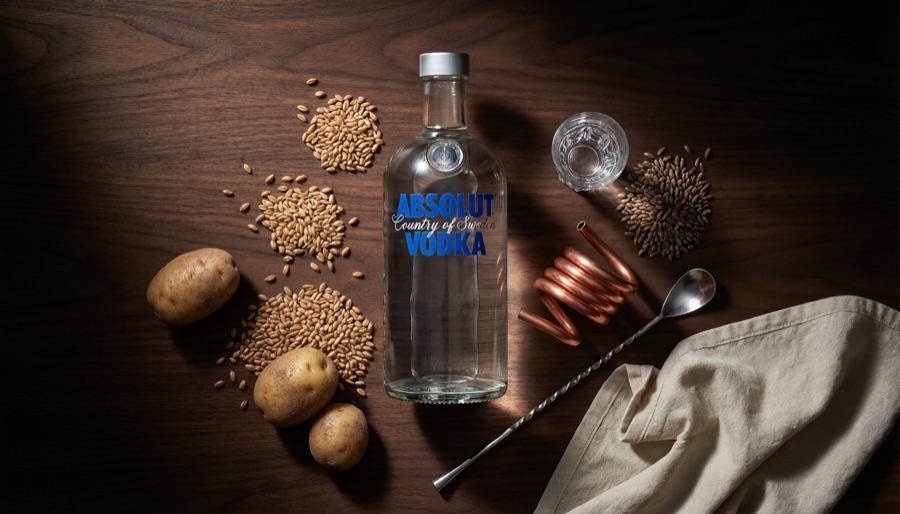
The base material sets the undertone of whatever flavor survives. Wheat vodkas taste clean, with faint anise and citrus-peel notes and a light body - Absolut and Grey Goose are the typical references; rye vodkas carry nut and spice, with a firmer body and a drier finish, in the line of Belvedere and Zubrowka; potato vodkas are oily and creamy, with earthy notes and a distinctly heavier mouthfeel, Chopin being the usual benchmark; corn and molasses bases lean sweet and neutral respectively. In blind tasting, judge the raw-material family by palate weight first and confirm with aroma - far more reliable than guessing brands outright. Hence the first rule of bar selection: when the drink needs the spirit to disappear, reach for wheat or corn; when the spirit must carry the base, reach for rye or potato.
Distillation and Filtration: How Process Shapes Texture
The number of column distillations sets the congener load: more passes bring the liquid closer to a pure ethanol-water solution. Over-rectification, however, strips texture as well, leaving the spirit "empty" in long drinks, which is why most premium houses stop at four to six passes. Filtration matters too: activated charcoal adsorbs aldehydes and fusel oils, and contact time and temperature directly set adsorption efficiency, while quartz sand and cellulose beds mainly polish mouthfeel rather than flavor. The marketing claim to distrust is "more filtration equals better" - filtration is a correction, not a source of quality; a well-made spirit is finished in the still. A second myth is treating freezer storage as quality: cold only suppresses aromatic volatility and hides flaws; it changes nothing about the spirit itself.
Flavor Schools: Western Neutrality vs. Eastern Character
The Western school, led by Sweden and France, pursues absolute neutrality to serve drinks where other ingredients lead - the Martini, the Espresso Martini. The Eastern school, rooted in Polish and Russian tradition, keeps the raw material's character, insisting on rye's spice and potato's creaminess, and suits sipping or vodka-forward recipes; Poland's bison-grass vodka even turns deliberate flavoring into a tradition. Neither school is superior; they answer different briefs. A home bar does well to keep one bottle from each school, which covers the structural needs of most recipes. For blind-tasting practice, build the same recipe with a representative bottle from each school and compare structural support - far more instructive than memorizing tasting notes.
Bar Application: Match the Spirit to the Drink's Structure
In built drinks (Screwdriver, Mule) vodka is the only spirit present, so a medium-bodied bottle with a whisper of raw-material character adds depth; in a Martini, vodka negotiates with vermouth, so pick a neutral, clean-finishing bottle that will not shout - ratios from 6:1 to 8:1 are both worth testing, and each ratio implies a different bottle; in cream-coffee builds like the Espresso Martini the body must stand up to sugar and fat, where rye or potato bottles hold firmer; clarified and molecular preparations demand absolute neutrality, since residual esters interfere with clarification. A "structural need to raw material" map survives service better than a memorized brand list.
More tips

278 cocktail recipes, one tap away
Browse by base spirit, flavor and strength. Save your favorites.
Open MixMyth