The Toddy Family Deconstructed: The Hot-Drink Formula of Spirit, Sugar, Water and Spice
The Toddy Family: A Hundred-Year Formula for Hot Drinks
The Toddy existed long before the word "cocktail" was written into any dictionary. It began in the colonial ports of India and the Caribbean as a humble daily mix of local spirit, sugar and water taken for warmth and fortitude, then travelled the trade routes to Britain and America, where it became the classic hot-drink family of the winter bar. To understand the Toddy is to understand the underlying logic of every hot cocktail: it relies not on shaking or chilling, but on the balance between temperature, sweetness and aroma. And precisely because its structure is simple, the Toddy tests a bartender's control of detail more than most - water temperature, sugar dose and spice ratio all expose any slip directly on the tongue, with nowhere to hide.
I. The Four-Part Formula: Spirit, Sugar, Hot Water, Spice
The Toddy's skeleton has only four variables: spirit supplies body and heat, sugar supplies roundness and viscosity, hot water supplies volume and temperature, and spice supplies aroma and layering. The classic ratio is roughly 50 ml spirit, 1 teaspoon sugar, 80-120 ml hot water, with spice to taste. This is not a law but an adjustable baseline: the more spirit, the hotter and sharper the drink, and the more sugar it needs to round the edges; the more water, the lighter the body, and the more it leans on spice for presence. The form of the sugar also matters: white sugar dissolves fast but tastes one-dimensional, while Demerara and honey add caramel and floral overtones, and maple syrup pushes the whole glass into an autumn-winter register. The bartender's job is to find, among these four variables, the balance that belongs to this particular glass.
II. Temperature and Dilution: The Core Tension of Hot Drinks
The greatest enemies of a hot drink are overheating and over-dilution. Water above 80 C scalds the tongue and boils off aroma; below 60 C the drink feels lukewarm and lifeless. The professional method is to warm the vessel first with 70-75 C water, then build the drink, so the serving temperature lands in the comfortable 55-60 C window. Dilution exists here too: the hot water is itself the diluent, so a Toddy needs no extra water; but the sugar must run slightly higher than in a cold drink to compensate for the way heat distorts the sweetness curve - hot drinks lose heat fast and turn bitter on the finish, so sugar must be front-loaded, not patched in afterwards. Another overlooked variable is time: for every minute a Toddy sits, temperature falls and spice keeps infusing, so the flavour curve is always moving; it should be enjoyed promptly, not sipped until cold.
III. Spice and Citrus: Two Routes to Aroma
A Toddy's aroma comes from two routes. The first is dry spice: cinnamon stick, clove, nutmeg and allspice, which tolerate long steeping and release slowly, suiting insulated mugs meant to stay warm. The second is fresh citrus: a lemon wheel, an orange slice studded with cloves, or a single expressed twist of peel, giving a bright top note. The two routes may be combined, but with restraint - one cinnamon stick plus an orange slice carrying three cloves is already enough. Over-spicing buries the spirit's own character and reduces the Toddy to a faceless spice-water. Citrus handling matters too: express the peel oils above the rim so the mist lands on the surface rather than dropping the peel into the drink, otherwise the peel's bitter compounds extract rapidly at heat and ruin a clean finish.
IV. The Variant Lineage
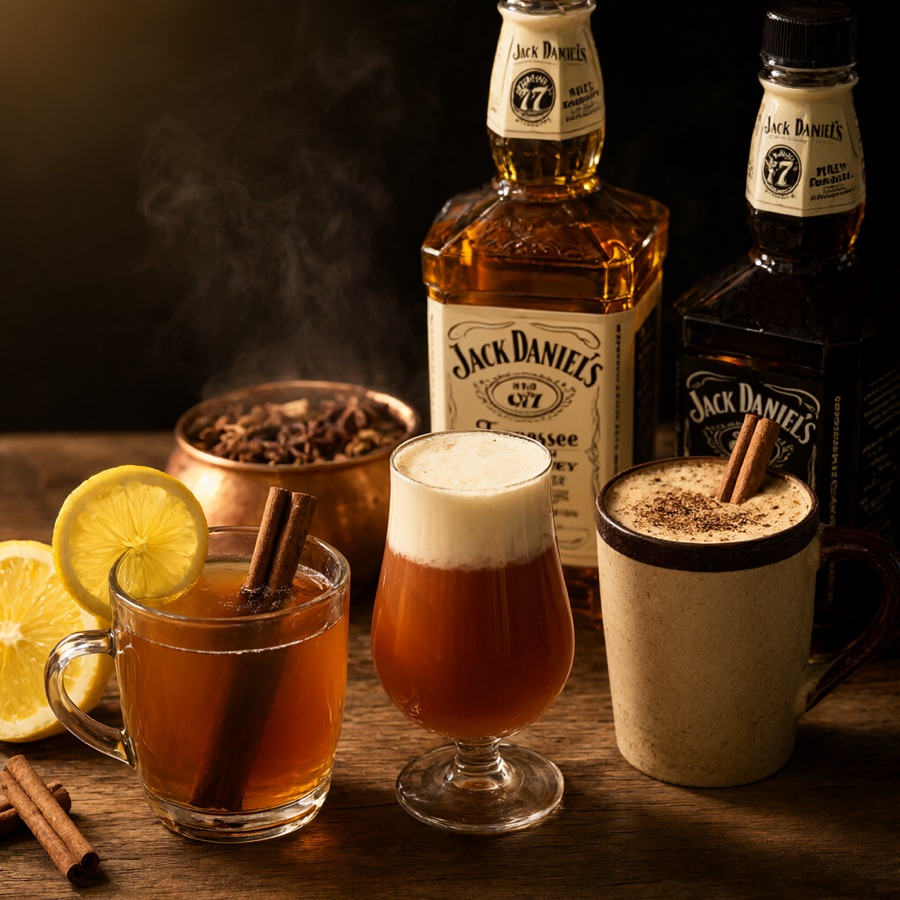
Using the four-part formula as coordinates, the whole hot-drink family comes into view. The Hot Toddy is the prototype: whiskey, sugar, hot water, lemon and spice. The Irish Coffee swaps hot water for hot coffee and sugar for Demerara, then floats a cap of cream. Hot Buttered Rum replaces part of the sugar with a butter batter for a heavy, silky body. Mulled Wine takes red wine as its base and steeps spice at length. The Ginger Tea Toddy exchanges the water phase for ginger tea, while the Hot Sake Toddy swaps whiskey for sake along an Eastern line. Their differences lie not in structure but in the substitution logic of the water phase and the fat phase: changing the water phase shifts the flavour canvas, while changing the fat phase shifts the weight on the palate.
V. Vessel and Presentation
Vessel choice directly governs heat retention and hand-feel. Handled glass mugs and ceramic mugs dominate - the former shows the drink's colour, the latter holds heat better - while Irish Coffee uses a stemmed glass to carry its cream float. Whichever is chosen, warming the vessel is non-negotiable. For presentation, a cinnamon stick leaning on the rim and a clove-studded orange slice floating on the surface are at once the classic visual signature and a continuing source of aroma; resist piling on garnish, since the rising steam of a hot drink is itself the best presentation.
VI. Common Mistakes
First, pouring boiling water straight in, scalding the tongue and losing all aroma. Second, under-sugaring, leaving a bitter, astringent finish. Third, over-spicing, burying the base spirit. Fourth, skipping the cup-warming step, so the drink crashes in temperature and closes up in a cold vessel. Fifth, under-stirring, letting sugar settle so the first sips are thin and the last are cloying. Sixth, letting it sit too long, losing both heat and aroma. Avoid these six and a Toddy is most of the way there; the rest is left to the winter night and the fire.
More tips
334 cocktail recipes, one tap away
Browse by base spirit, flavor and strength. Save your favorites.
Open MixMyth