Tea and Coffee in Cocktails: A Complete Guide to Extraction, Cold Brew and Flavor Pairing
Tea and Coffee in Cocktails: A Complete Guide to Extraction, Cold Brew and Flavor Pairing
Tea and coffee are the two most widely used "non-alcoholic flavour ingredients" on the modern bar. What they bring is not sweetness or acidity but an entire complex spectrum of roast, floral, fruity, tannic and bitter notes - the depth and layering that spirits and citrus alone cannot supply. Using them well is not a matter of casually pouring a shot of espresso into a drink; it means understanding the extraction logic, choosing the right form, controlling the key parameters, and knowing which base spirit each one pairs with and which traps to avoid.
I. Extraction Logic: How Flavour Compounds Decide the Method
The flavour of coffee and tea comes from compounds of differing solubility, and they enter the water in a fixed order. In coffee, fruit acidity and florals dissolve first (especially in light roasts), then the sweetness of sugar, nut and cocoa, and only finally bitterness and woody tannins; in tea, the amino-acid sweetness releases first, then the astringency of catechins, then polyphenols and aromatic oils. This "bright-to-bitter" curve sets the strategy for putting them into drinks: over-extraction lets bitterness and astringency swamp everything and leaves the drink dull and harsh, while under-extraction leaves a thin flavour that cannot carry the body once ice and spirit dilute it. For this reason, coffee and tea destined for cocktails are usually extracted stronger than for drinking straight - the concentration is not the goal but the headroom left for later dilution, so the finished drink lands back at exactly the right intensity in the glass.
II. Four Forms of Coffee in a Drink
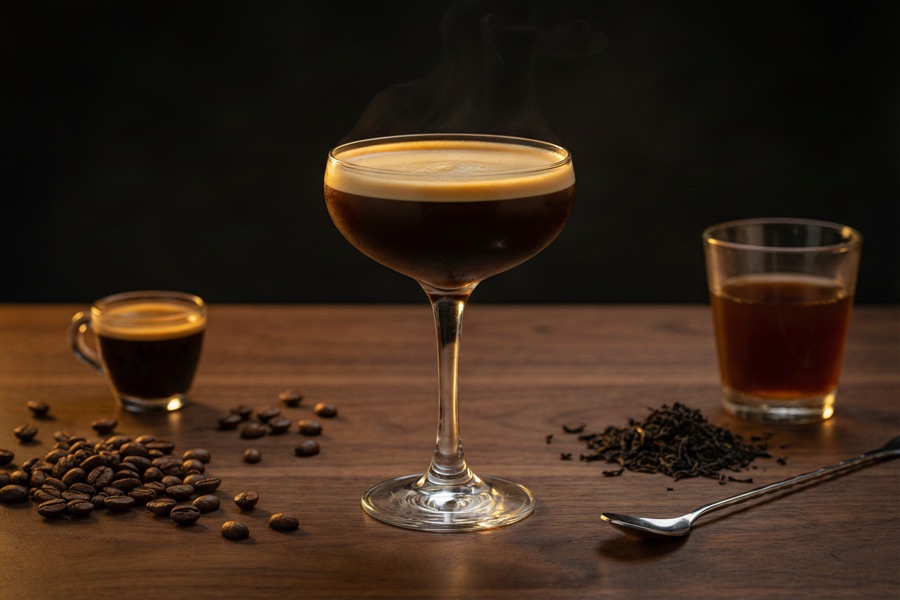
Espresso is the most concentrated and oil-rich form, the soul of the Espresso Martini, able to carry the body of a short drink and leave that fine layer of crema after shaking; cold brew, extracted long at low temperature, is low in acidity, round in sweetness and almost free of harsh bitterness, suited to long drinks and clarified preparations; coffee syrup binds the extraction to sugar in advance for precise dosing and consistent output, the first choice of a commercial bar; and coffee liqueur (such as Kahlua) is a pre-sweetened, ready-made ingredient that acts as both sweetener and flavour source. Choose according to the intensity and sweetness the recipe needs: for a strong, foamy short drink use espresso; for a smooth, clean long drink use cold brew; for stable sweetness and consistency use syrup.
III. Ways to Bring Tea into a Drink
Tea follows the same logic as coffee but is even more sensitive to temperature and time. Hot brewing with a fast pour-off captures aroma and suits short drinks that need a bright tea note; cold brewing (6-12 hours) captures smoothness and low astringency and suits long drinks and clarification; tea syrup eases dosing and storage; and a spirit can be infused directly with leaves to make a tea-washed spirit, letting the tea aroma grow into the base itself. Each tea type has a role: Earl Grey's bergamot suits gin and whiskey, matcha's fresh bitterness pairs with white chocolate and rum, oolong's floral-fruit notes go with tequila, and black tea's malty depth matches bourbon. Green tea is delicate and turns bitter at high temperatures, so use 70-80C or cold brew it directly to preserve its lifted aroma.
IV. Key Parameters: Ratio, Grind, Temperature and Time
Parameters are the foundation of putting tea and coffee into drinks. Cold-brew coffee typically uses a 1:8 to 1:10 coffee-to-water ratio, a coarse grind, and 12-18 hours at room or fridge temperature; espresso uses a fine grind, 9 bar of pressure and about 25-30 seconds to yield roughly 30 ml. For hot-brewed tea, use about a 1:50 leaf-to-water ratio, water from 70-95C depending on the tea, and steep 2-4 minutes, removing the leaves as soon as it is poured to avoid astringency. Every extraction should be fully chilled and filtered before it meets the drink: hot liquid poured straight onto ice dilutes instantly and drives off the aromatics, so pre-chilling or an ice bath is the reliable approach. Grind matters just as much - too fine a grind in cold brew brings over-extracted harshness, too coarse leaves it under-extracted and hollow.
V. Texture and Clarification: Bringing Tea and Coffee into Finer Structures
Beyond going straight into a drink, tea and coffee can enter finer structures through clarification. Milk washing uses casein to bind tannins and pigment, turning a strong tea or cold brew into an amber, silky, transparent clarified liquid that keeps the aroma while stripping the astringency - ideal for a clarified tea martini; gelatin or agar clarification retains more body. Coffee can likewise be combined with cream or egg yolk to build rounded flip and eggnog-style structures. The essence of texture engineering is this: first decide whether the drink should be "clear" or "rich," then choose clarification, fat or foam to achieve it.
VI. Pairing and Common Mistakes
For pairing, follow "like attracts, contrast complements": coffee's bitterness complements sweet drinks (Baileys, maple) and shares a lineage with dark spirits (bourbon, dark rum), while tea's lifted florals brighten gin and tequila and matcha's fresh bitterness cuts through the richness of cream. There are three common mistakes: pouring overnight coffee or over-steeped tea straight into a drink, where the oxidised sourness cannot be masked; ignoring dilution, so a concentrated extraction leaves no room for the ice and the result is too strong and bitter; and unbalanced sweetness, since the bitterness of coffee and tea needs ample sugar or fat (cream, egg yolk) to round it out - cutting sugar too far leaves the whole drink sharp and thin. Master these points and tea and coffee move from a garnish to the flavour backbone of a cocktail.
More tips

276 cocktail recipes, one tap away
Browse by base spirit, flavor and strength. Save your favorites.
Open MixMyth