Sugar and Sweeteners: A Complete Guide to Cane, Honey, Maple and Invert Sugar in Cocktails
Sweetness Is Structure, Not Background
In a cocktail, a sweetener carries three jobs at once: balancing acidity and bitterness, shaping texture and body, and contributing aromatic layers beyond sugar itself. Beginners treat "sweet" as a single dial and adjust only the amount; professional bartenders ask three questions first: how quickly does the sweetness arrive and how long does it linger, how much viscosity and body does it add, and what non-sugar flavors does it bring along? Once those three layers are separated, the differences between the seven mainstream sweeteners - cane sugar, honey, maple, agave, invert sugar, cane molasses and flavored syrups - become obvious.
Simple Syrup: Ratio and Heat Decide Everything
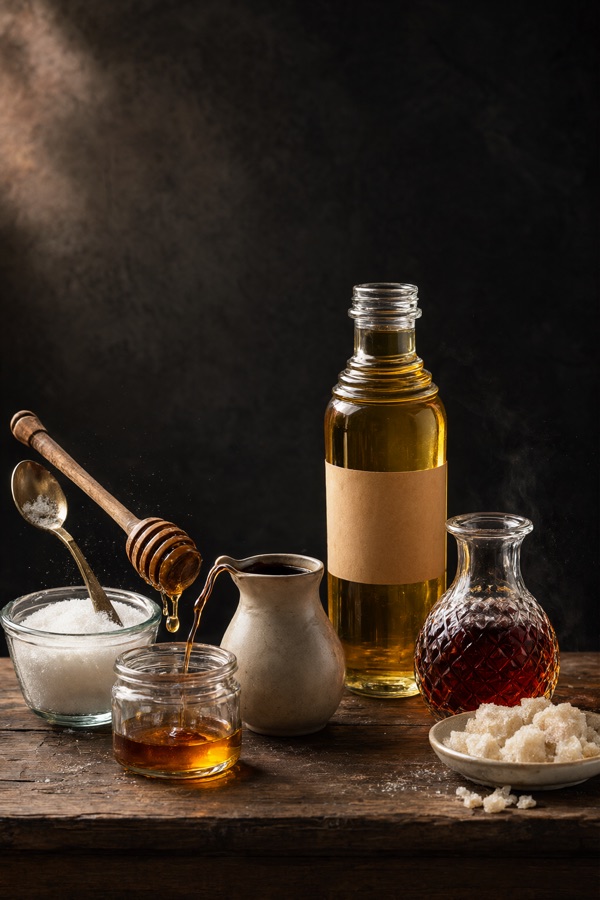
The industry default is 1:1 simple syrup (sucrose and water by weight), about 50% sugar, which sweetens precisely without changing the drink's volume much. Rich syrup (2:1) sits near 66% sugar with noticeably higher viscosity, so less of it reaches the same sweetness - the gain is less water in the glass, which matters for stirred spirit-forward drinks like the Old Fashioned and Manhattan; the cost is a sticky texture if total dilution is not recalculated. Two production rules: dissolve in water around 50 C and never boil - boiling evaporates water, wrecks the ratio and creates a "cooked sugar" note that masks delicate aromas; and store each liter sealed in the fridge with 5 ml of neutral high-proof spirit or 1 g of citric acid for roughly a month, while room temperature brings crystallization and off-flavors within a week. Always weigh, never scoop: packing density alone can push volume measurements off by more than 10%.
Honey and Maple: Sweeteners With Their Own Voice
Honey's sweetness arrives fast and fades fast, carrying blossom aromas and a faint fruity acidity; straight from the jar it is too viscous to blend evenly in a shaker, so it is first cut 3:1 or 2:1 (honey to warm water) into honey syrup. In a Bee's Knees that syrup is the soul: it wraps gin's juniper edges and lemon's sharp corners at once and leaves a warm finish. Color is honey's flavor map - dark buckwheat and wildflower honeys are assertive and suit whiskey and rum; pale acacia and orange-blossom honeys are clean and suit gin, vodka and sparkling drinks. Maple syrup's sweetness comes with wood and caramel notes plus a faint mineral edge, a natural partner for rye - a Maple Old Fashioned simply replaces simple syrup with it - but its voice is dominant, so in aromatic delicacy it should stay under a quarter of total sweetness.
Invert Sugar and Cane Molasses: The Classical Power Tools
Invert sugar is sucrose hydrolyzed into glucose and fructose: sweeter than sucrose, more soluble, and far less prone to crystallizing. Most pre-Prohibition recipes that say "syrup" mean invert syrup; modern bars rely on it for bottled pre-batches and cordials to prevent graininess and stabilize texture. Cane molasses and demerara syrup bring treacle, toffee and a lightly saline bitter edge - the standard partner for the rum family, and the source of depth in old-school Mai Tais and Daiquiris; their color also tints the drink, so pale builds need a preview. One detail: fructose reads sweeter when cold, so chilled and frozen drinks take about 10% less nominal sweetness to avoid turning cloying as they warm; hot drinks move the other way, half a notch up.
Agave Nectar and Flavored Syrups: Boundaries and Pairings
Agave nectar is flat-sweet with a short finish and viscosity between honey and simple syrup - the "same-origin" sweetener for agave spirits, which is why Tommy's Margarita swaps orange liqueur for it and gains a cleaner body; but it lacks aromatic complexity and feels empty carrying a drink alone. Flavored syrups (orgeat, falernum, grenadine, cinnamon) are sweetness carriers plus flavor carriers: dose them for sugar and for flavor at once, because excess turns a drink cloying or lets the syrup shout over everything. The house parameter for homemade versions is extraction into 1:1 sugar water - nuts roasted then cold-infused 12 hours, spices hot-infused 20 minutes - then strained and fortified with 5% high-proof spirit for shelf life.
Conversions, Sugar Rims and Three Classic Mistakes
Rough sweetness-equivalent volumes: 1 part 2:1 rich syrup equals about 1.5 parts 1:1 simple, about 2 parts 2:1 honey syrup, about 2 parts agave syrup; compensate the water difference when substituting. The sugar rim is sweetener in another form: the Crusta's full rim or the Margarita's half salt half sugar rim controls where and how much sweetness touches the lips first - rim half the mouth only and leave the drinker the choice. Three recurring mistakes: dropping granulated sugar straight into the shaker, where cold prevents full solution and the drink ends grainy and inconsistently sweet; treating every "syrup" as interchangeable, when orgeat, falernum and grenadine are flavored syrups and swapping them rewrites the whole flavor structure, not the sweetness; and ignoring temperature - the colder the drink, the duller the sweetness, so frozen builds and long drinks go half a notch sweeter while hot toddies go down. Memorize each sweetener's sweetness curve, viscosity and aromatic layer, and both substitution and creation gain a firm footing.
More tips
320 cocktail recipes, one tap away
Browse by base spirit, flavor and strength. Save your favorites.
Open MixMyth