The Complete Guide to Cocktail Strainers: Hawthorne, Julep and Double Straining
The Complete Guide to Cocktail Strainers: Hawthorne, Julep and Double Straining
The strainer is the third core tool after the shaker and the mixing glass: it separates the liquid from ice, fruit pulp and herb fragments, and directly decides the clarity and texture in the glass. Many people start with a three-piece shaker whose built-in mesh means they never buy a strainer; but the moment they switch to a Boston shaker or take stirred short drinks seriously, the strainer goes from "nice to have" to "indispensable". This guide walks through the structure, use cases and double-straining logic of the three mainstream strainers.
1. The Hawthorne Strainer: The Default for Shaken Drinks
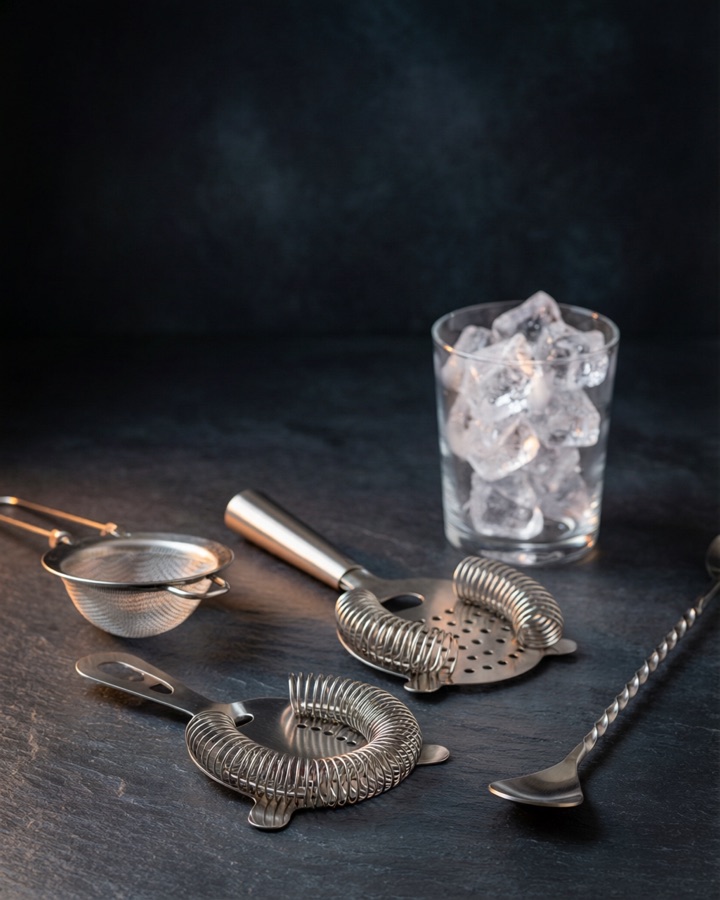
The Hawthorne strainer was born in late nineteenth-century America, identified by the coil spring around its disc. The spring hugs the mouth of the tin and holds back large ice, while the liquid flows out through the half-moon openings in the plate. It takes its name from Boston's Hawthorne Café, where this spring-ringed strainer was used so widely that the name stuck; the early spring was a simple C-shape, and a century of evolution produced today's multi-coil spring with four prongs, the prongs hooking over the outside of the tin to keep the strainer from sliding sideways while pouring. Its fit is decided by disc diameter and spring diameter: mainstream models fit standard Boston tins and cobbler bodies; a loose spring slides and leaks ice while pouring, an overtight one is a fight to fit and remove. Technique: press the handle with your index finger, spring down against the tin; the steeper the pour angle, the faster the flow. For a cleaner pour, press the disc low and leave only a thin gap. The Hawthorne's weakness is fine ice shards and pulp - when shaking mint, berries or egg white, fragments slip through the spring, and that is when double straining enters.
2. The Julep Strainer: The Mixing Glass Partner
The julep strainer is a perforated concave metal disc with a handle, older than the Hawthorne and designed for the mixing glass. Stirred drinks carry no pulp, only large ice; the julep's bowl cups the ice and lets the liquid run smoothly through the holes, giving a steadier pour than the Hawthorne - the traditional choice for stirred short drinks like the Martini and the Manhattan. It also extends the bar spoon: press the bowl lightly on the floating ice to control the last few drops. When buying, match the bowl's curve to your mixing glass's inner diameter; too shallow a bowl cannot hold back floating ice. A home bar that only shakes can postpone the julep; once stirred drinks enter the routine, it is handier than the Hawthorne.
3. The Fine-Mesh Strainer and Double-Straining Logic
The fine strainer is a small conical mesh sieve; on its own it strains tea or syrup, but in bartending its core role is the "second gate": after a shaken drink passes the Hawthorne, it runs through a fine strainer resting on the glass, catching ice shards, fruit fibers and coagulated egg white for a silky, clear body - this is the double strain. Whether to double strain depends on the recipe: drinks with muddled ingredients, fresh fruit or egg white almost always need it; spirit-only stirred drinks do not - over-filtering costs aroma and texture. Note that finer mesh is not always better: an overly fine sieve slows the flow dramatically, and the drink warms while it waits in the mesh. Handling matters too: pour with one hand while the other holds the fine strainer by its handle, its rim resting on the glass, so the liquid passes through the mesh into the cup; when the pour ends, tap the strainer's rim twice to shake off the clinging drops - and never scrape the residue out of the mesh with the bar spoon. Those shards and fibers are exactly what you intercepted; scraping them into the glass undoes the whole exercise.
4. Materials, Sizing and Common Mistakes
The mainstream material is 304 stainless steel; the spring's temper decides lifespan - cheap springs go slack and deformed within months. Titanium strainers are lighter and stiffer and suit long-shift, high-volume bartenders, at a higher price; copper and gold finishes are plating or coating, decorative attributes whose color chips off with repeated knocks, and are best kept off the workhorse slot. For sizing, a Hawthorne disc of six to seven centimeters covers most tins; measure your tin's inner diameter before buying. Mistake one: the cobbler's built-in mesh is enough - its holes are large and the seams weep, an obvious gap with egg-white drinks. Mistake two: the tighter the spring the better - an overtight spring is hard to fit and scratches the tin's plating. Mistake three: strainers can go in the dishwasher - acidic residue trapped in the spring corrodes the solder points; rinse with warm water and shake dry instead. For care, remove the Hawthorne's spring and scrub it separately, brush the julep's holes with a soft brush, and let the fine strainer dry upside down.
5. Kit Recommendations
The minimum home kit: one Hawthorne, covering every shaken scenario; add one fine strainer to double-strain fruit-heavy recipes; add a julep when stirred drinks join the menu. The three together cost little, yet they are the cheapest stretch of road between "drinkable" and "delicious".
More tips
274 cocktail recipes, one tap away
Browse by base spirit, flavor and strength. Save your favorites.
Open MixMyth