The Sour Family Deconstructed: The Golden Triangle of Spirit, Citrus and Sugar
The Sour Family Deconstructed: The Golden Triangle of Spirit, Citrus and Sugar
The sour is the oldest and most rigorously tested family of cocktails in the world. Its frame is almost formulaic - a measure of spirit, a measure of citrus acid, a measure of sweet - yet within that single triangle sit nearly all the great short drinks: the Margarita, Daiquiri, Sidecar, White Lady, Whiskey Sour and Pisco Sour. Understanding sours is not about memorising a few ratios; it is about mastering a logic of balance that lets you reason your way through the entire family. Only when you know what each element contributes to the structure can you depart from the classics and still build a drink that stands up.
I. The Golden Triangle: the Quantitative Frame of Spirit, Acid and Sweet
The classic sour ratio is often written as "2 parts spirit : 0.75 part acid : 0.75 part sweet," which is also the IBA baseline for the Whiskey Sour and the Daiquiri. It holds because each element has a distinct job: the spirit supplies aromatic body and structure, the acid lifts and tightens, and the sweet stitches over the sharp edge between acid and spirit. The key is to treat the ratio as a starting point rather than a creed - when the base is flavourful (aged rum, rye), drop the sweet slightly and raise the acid for a leaner structure; when the base is quiet (vodka, white rum), let acid and sweet carry the flavour. The professional method is simple: build one drink at 2:0.75:0.75, taste it, then adjust along the acid-sweet-spirit triangle one variable at a time until the entry has layers, the middle has weight and the finish is clean rather than sweet.
II. Choosing the Acid: Lemon and Lime Have Different Temperaments
Almost all sour acidity comes from citrus, and lemon and lime behave very differently. Lemon is rounder, with floral and peel-forward aromatics, and it pairs with complex spirits such as gin, whiskey and brandy - the Whiskey Sour, White Lady and Sidecar all use lemon. Lime is sharper and greener, with a tropical edge that naturally suits rum and tequila - the Daiquiri, Margarita and their whole lineage use lime. Two rules are non-negotiable: always squeeze fresh, because the oxidised flavour of bottled juice destroys a drink's brightness; and use citrus within about two hours, since it turns bitter and flat as it sits. Beyond citrus, verjus, blended malic and citric acid, and drinking vinegars (shrubs) offer different acidity curves for flavour extension or for reducing reliance on citrus.
III. The Sweet Variable: How Syrup, Liqueur and Honey Rewrite the Structure
"Sweet" in a sour is far more than a spoon of syrup - it changes sweetness, aroma and alcohol at once. The most neutral is simple syrup (1:1 or 2:1), which adds sweetness without noise and suits drinks meant to spotlight the base. Liqueur is "sweetness with aroma": the Margarita and Sidecar use Cointreau or triple sec, which sweeten while injecting orange-peel perfume and extra proof - precisely why they feel more three-dimensional than a plain-syrup version. Honey and agave are more viscous and more assertive; honey must be thinned into a honey syrup to shake evenly, while agave is drawn to tequila by kinship. Choosing a sweetener is really about adding one more aromatic note to the triangle, and choosing wrongly makes the drink cloying or overbearing. The principle: keep the sweet restrained and neutral for a delicate base, and let it carry flavour to support a robust one.
IV. The Family Tree: From Crusta and Daisy to the Modern Sour
Today's sour did not appear from nowhere but along a clear line of descent. The nineteenth-century Crusta rimmed the glass with sugar and dressed the spirit with a little citrus and liqueur - the prototype of the garnished sour. The Daisy that followed added syrup and crushed ice, fixing the spirit-citrus-sweet trio and directly giving rise to the Margarita (a tequila Daisy). Meanwhile the word "Sour" came to denote the shaken short drink of spirit, citrus and sugar, with the Whiskey Sour as its emblem. From there the family branched in two directions: lengthened with soda it became the Fizz and the Collins; enriched with egg white it became the Boston Sour and foam-driven drinks like the Ramos Gin Fizz. The Margarita, Daiquiri, White Lady, Pisco Sour, Amaretto Sour and Last Word are all, at bottom, the same triangular frame varied across different bases, sweeteners and textures.
V. Texture Engineering and Calibration: Egg White, Dilution and Triangle Tweaks
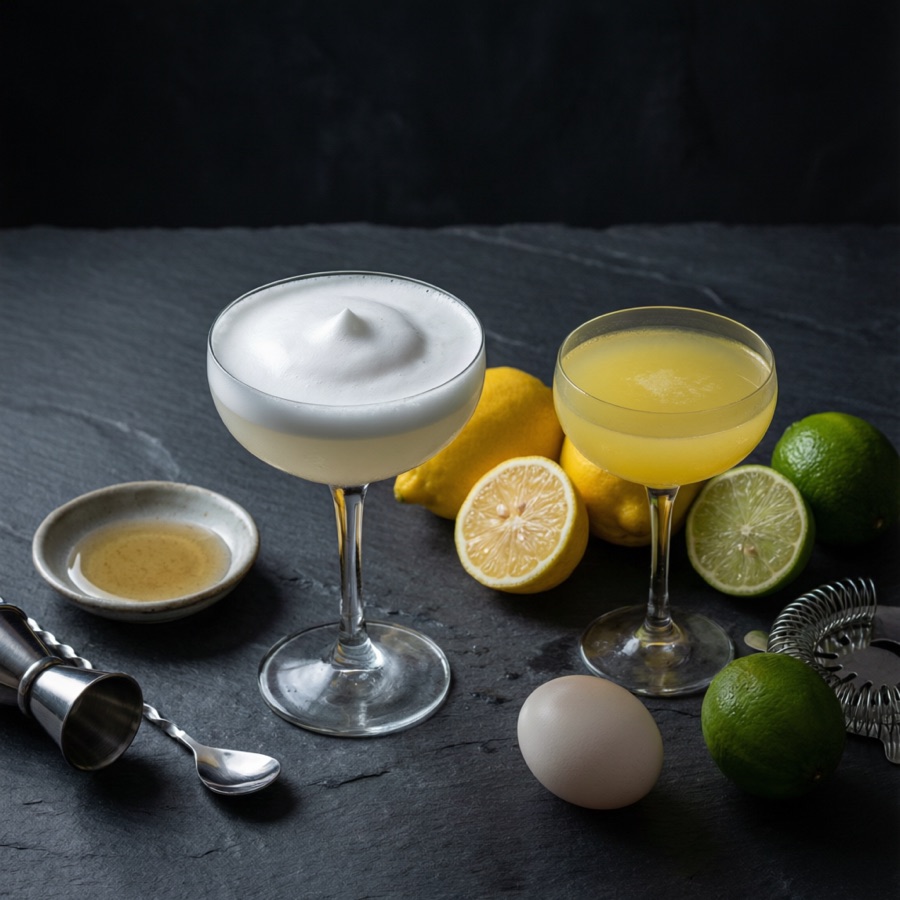
The final craft of a sour lives in its texture. Adding an egg white (or aquafaba for a vegan version), dry-shaking it without ice to build foam and then shaking again with ice, yields a dense, mousse-like head that traps aroma, softens acidity and rounds the mouthfeel - the source of the silky finish in a Boston Sour or Pisco Sour. Dilution is just as critical: a sour is usually shaken for 12-15 seconds, only until the tin frosts over; over-shaking lets meltwater flatten the structure, while under-shaking leaves the drink too warm and diffuse. For calibration, keep one reusable method: if the result is dull, add acid (5 ml at a time); if it is sharp, add a touch of sweet or a few drops of saline; if it is thin, raise the spirit proportion or add body with glycerol or 2:1 rich syrup. Always adjust one variable at a time and taste as you go. Once you can reason out any sour from this triangular logic, you truly own the whole family.
More tips
274 cocktail recipes, one tap away
Browse by base spirit, flavor and strength. Save your favorites.
Open MixMyth