A Complete Guide to Fermented Flavours in Cocktails: Shrubs, Drinking Vinegars and Lacto-Fermentation
A Complete Guide to Fermented Flavours in Cocktails: Shrubs, Drinking Vinegars and Lacto-Fermentation
Fermentation and acidification are humanity's oldest preservation techniques - and one of the modern bar's richest flavour mines. Unlike the bright, direct acidity of citrus, vinegar and lacto-fermentation deliver a layered acid with a sense of time: the fruit's sweetness and perfume, plus the complex esters and mellow sourness produced by microbial metabolism. Mastering the two technical lines of shrub (drinking-vinegar syrup) and lacto-fermentation lets you build a deep, drinkable acid backbone without leaning on large amounts of spirit.
I. The Essence of a Shrub: The Triangular Balance of Sugar, Vinegar and Fruit
The shrub descends from the colonial practice of preserving fruit juice with vinegar. Its core is the balance of three elements: fruit supplies aroma and natural acidity, sugar supplies body and preserving power, and vinegar supplies a stable, sharp acidity and a microbial barrier. Their ratio decides whether the result is a sweet-leaning syrup or an acid-forward concentrate. The classic starting point is equal weights of fruit and sugar (1:1); once the juice has been drawn out, vinegar is blended in at roughly one-third to one-half by volume. Sugar is not only a sweetener but the source of osmotic pressure - it pulls the juice out of the flesh while suppressing spoilage organisms. Understand this and you can flex the ratio to the target drink: lean more acidic for long drinks, sweeter for shaken bases.
II. Cold Maceration vs Hot Cook: Two Shrub Methods and Their Ratios
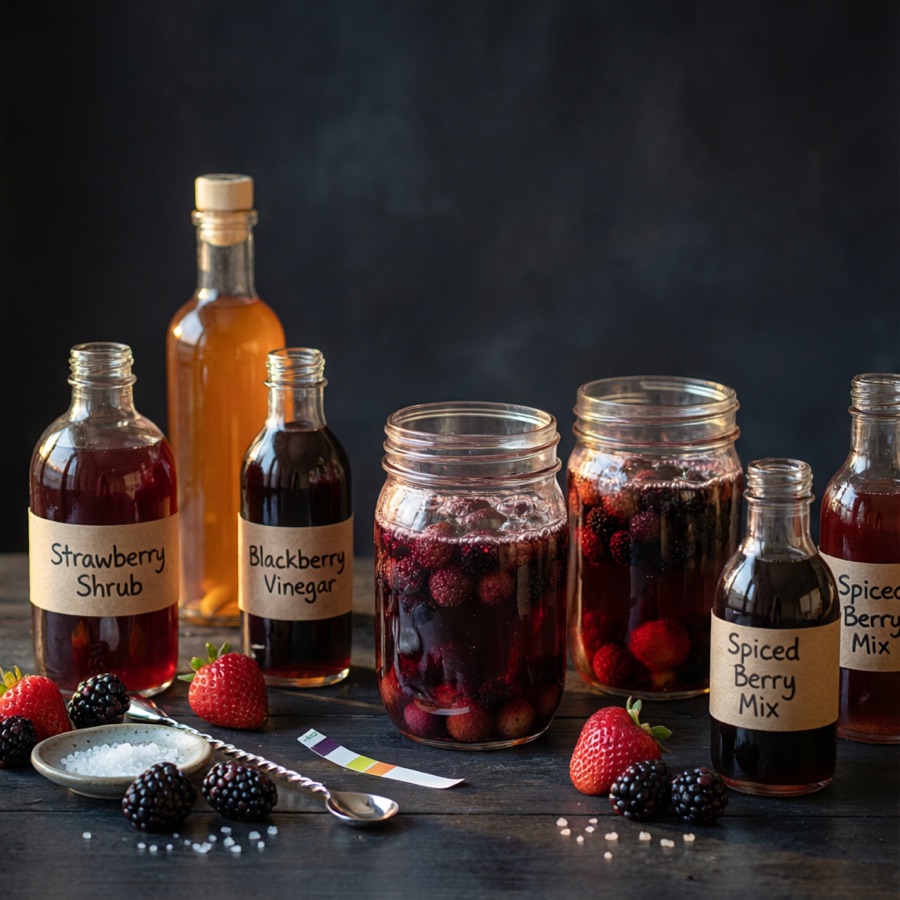
The cold method preserves the fruit's most vivid aromatics: combine chopped fruit and sugar 1:1, macerate refrigerated for 12-48 hours, strain off the flesh once the sugar has drawn out the juice, then stir in vinegar and bottle. Its virtues are bright aroma and clear colour; its costs are time and a slightly lower yield. The hot method is faster and more concentrated: simmer fruit, sugar and a little water until soft, cool, strain, then add vinegar - done in half an hour, ideal for pectin-rich berries and large batch prep, at the price of losing some volatile aromatics to heat. Either method benefits from a further week of rest so the flavours marry and the vinegar's sharp edge rounds off with time.
III. Choosing a Vinegar: Flavour Logic from Cider to Sherry
Vinegar is the shrub's backbone, and the choice should serve the fruit and the target flavour. Cider vinegar is mild and fruity, the safe all-rounder; red wine vinegar is robust and forceful, suited to dark berries such as blackcurrant and blackberry; sherry vinegar and balsamic carry nutty, caramel-like sweetness, ideal for autumn drinks and aged spirits; rice vinegar is light and gentle, the least intrusive partner for citrus and Asian fruit; and white champagne vinegar is fine and elegant, the choice for a refined aperitif. The principle is that the vinegar's strength must match the fruit - avoid an overbearing vinegar that buries the fruit, and avoid a thin vinegar that cannot hold the structure. Unfiltered cider vinegar containing the "mother" is more complex in flavour, but must be refrigerated and watched for cloudiness.
IV. Lacto-Fermentation: Injecting Living Acid and Aroma into Cocktails
Lacto-fermentation is the hot technique of the contemporary avant-garde bar: combine fruit with salt at 2% by weight, seal under vacuum or an airlock to exclude oxygen, and leave at room temperature for several days so wild lactobacilli convert sugar into lactic acid. The product is a soft, faintly saline "living acid" with savoury depth and a whisper of effervescence - rounder than vinegar, more complex than citrus. It can go straight into a drink as a lacto syrup, or supply a near-convincing body and acidity to zero-proof cocktails. The keys are controlling salt (2% is the safety line), maintaining an anaerobic environment, and confirming with pH strips that the ferment has dropped below 4.0 before refrigerating to halt it.
V. Dosing, Balance and Common Mistakes
Shrubs and ferments are essentially compound seasonings of "acid plus sugar"; the working dose in a drink is usually 15-30 ml, replacing part of the citrus and syrup in a recipe rather than all of it. The most common mistake is adding them like plain syrup, overloading the drink with sweetness and acid and wrecking the balance; the correct approach is to start low, add while tasting, and dial back the recipe's existing sugar and fresh acid accordingly. The second mistake is ignoring food safety: every ferment should have its pH checked, be refrigerated and dated, and anything showing off-flavours, mould or abnormal gas must be discarded. The third is forgetting that a shrub changes over time - make small batches and use them promptly. Treat fermentation as a controllable science of acidity, and it becomes the deepest note in your flavour toolkit.
VI. In-Drink Application: Wiring Fermented Acid into Classic Structures
The safest way to use a shrub or lacto acid is to replace part of the fresh citrus in a classic sour structure: swap 20 ml of strawberry shrub for roughly half the lime and all the syrup in a Daiquiri, then top up the remaining acidity, and you have a variant with drinking-vinegar depth; in a sparkling long drink, 15 ml of blackberry shrub with gin and soda is a more three-dimensional aperitif than plain syrup alone. Lacto ferments suit the savoury route: a little lacto pineapple juice lends tiki-style builds salinity and complexity, while lacto citrus-peel water gives zero-proof drinks a "bite" close to that of spirit. When applying them, remember that fermented acids carry their own sugar and salt - dial the recipe's sugar, salt and fresh acid down in step, calibrating by repeated tasting, so the drink keeps fermentation's sense of time without losing its cleanness and balance.
More tips

284 cocktail recipes, one tap away
Browse by base spirit, flavor and strength. Save your favorites.
Open MixMyth