Salt and Saline Solution: A Complete Guide to the Invisible Lever of Cocktail Balance
Salt and Saline Solution: A Complete Guide to the Invisible Lever of Cocktail Balance
Salt is the most underrated seasoning tool on a professional bar. It does not supply sweetness the way sugar does, nor shape the outline the way acid does; instead it quietly rewires how the whole drink is perceived - suppressing bitterness, lifting aroma, rounding the mouthfeel. Understanding how salt works, and mastering the preparation and dosing of saline solution, is the step that separates casual mixing from precise bartending.
I. Why Salt Changes Flavour: From Taste Physiology to Perception Thresholds
At low concentrations salt (sodium chloride) is not perceived as "salty" at all; it acts as a flavour modulator. Sodium ions dampen the signalling of bitter receptors on the tongue, pushing bitterness into the background, while simultaneously raising salivation and oral conductivity so that aroma molecules volatilise more readily and reach the nose - which is why sweetness and fruit appear amplified. This is exactly why two drops of saline in a bitter amaro or grapefruit drink make the bitterness recede and the fruit leap forward. Research also shows that trace salt lowers the amount of sugar needed for a given perceived sweetness, letting you replace part of the sugar with salt for a cleaner, lighter result. Salt's window is extremely narrow: below threshold it only modulates without tasting of salt; above threshold the whole drink turns briny and is ruined - so precise measurement is the precondition for everything that follows.
II. Why Saline Solution Rather Than Solid Salt
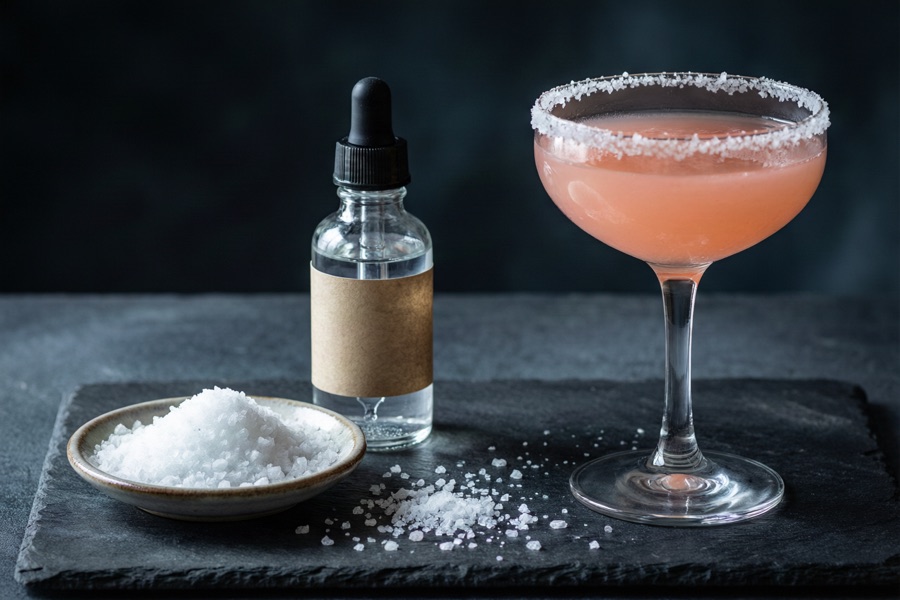
Sprinkling solid salt is nearly impossible to dose: the grain count, dissolution speed and distribution of a pinch are all unstable, and solid salt dissolves slowly in cold liquid, sinking to the bottom and yielding a drink that starts flat and ends salty. The professional standard is a pre-made 20% weight-ratio saline solution (20 g salt dissolved in 80 g water, i.e. 1:4) kept in a dropper bottle. In solution every drop carries a constant salt load, and a dropper delivers repeatable one-to-three-drop precision; because the salt is already fully dissolved it disperses instantly and evenly, with no sinking. Make it with warm water to speed dissolution, then chill, bottle and refrigerate - it keeps for months. For a softer mineral edge use sea salt or kosher salt instead of table salt, but always weigh rather than measure by volume, since crystal density varies enormously between salts: a teaspoon of fine salt and a teaspoon of flaky salt can differ by nearly half in actual salt content.
III. Dosing and Typical Applications
The working dose of saline is two to four drops per drink (about 0.1-0.2 ml), aiming for "no perceptible salt, only a more three-dimensional flavour." The drinks that benefit most fall into a few families: citrus and grapefruit (Paloma, Salty Dog), where salt tames the pith's astringent bitterness and lifts the fruit sweetness; coffee and cocoa (Espresso Martini, Grasshopper), where salt reins in harsh bitterness and foregrounds roast; savoury tomato and umami (Bloody Mary), where salt synergises with Worcestershire sauce to amplify umami; agave spirits, where salt echoes the mineral character of the terroir; and any drink built on coconut or cream, where salt cuts richness and lifts perfume. Beyond drops, the salt rim is salt's other form: salting only half the rim lets each sip carry its own measure of salt, ideal for the Margarita and Paloma, drinks already born to sit alongside salt.
IV. Choosing a Salt: Types and Logic
Table salt is pure and neutral, the safe default for saline; sea salt carries trace minerals and a rounder edge, suited to recipes chasing layering; kosher salt's flaky crystals dissolve easily and cling well to rims; celery salt is reserved for savoury builds like the Bloody Mary, bringing its own herbal-umami note. The question is not "which is better" but "which is more controllable": use fine table or sea salt, weighed, for solution, and flaky kosher or coarse sea salt, for adhesion, on rims. Avoid cheap salts heavy in anti-caking agents, and avoid iodised salt - iodine lends a faint metallic note that shows up most clearly in delicate, light-bodied drinks.
V. Common Mistakes and Working Practice
The most common error is overdosing: once salt is perceptible it is hard to rescue - you can only dilute and start again - so always begin at two drops, add drop by drop, and taste after each. The second mistake is treating salt as a sugar substitute without rebalancing acid: salt amplifies overall perception, but the acid-sugar ratio must still be balanced on its own, and cutting sugar usually calls for a small acid adjustment too. The third is failing to record: a professional spec writes saline drops into the recipe sheet exactly like bitters, because hand-feel output is inherently inconsistent. Finally, when salt is stacked with texture techniques such as clarification or fat-washing, set the texture first and the salt after, since a rounded body masks salinity and invites over-addition. Treat salt as a science of measurement rather than an instinct of seasoning, and it becomes the sharpest invisible lever in your flavour toolkit.
More tips

280 cocktail recipes, one tap away
Browse by base spirit, flavor and strength. Save your favorites.
Open MixMyth