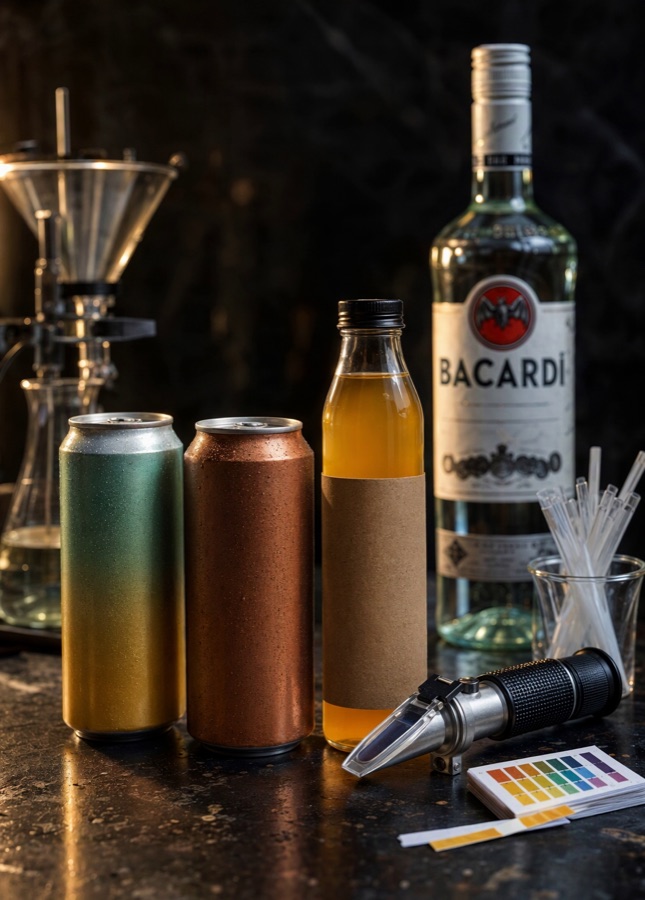
Rum RTD and Premix Stability: The Technical Framework of Oxidation, Esterification and Batch Consistency
Rum RTD and Premix Stability: The Technical Framework of Oxidation, Esterification and Batch Consistency
Rum is the most widely used base spirit in canned RTD cocktails and batched premixes: highly tolerant of other flavours, cost-effective and compatible with juice acidity. Yet a premixed rum punch losing its perfume by day seven, or a canned Mai Tai developing a cooked-fruit note after three months on the shelf, almost always traces back to the same technical nodes: oxidation, esterification and hydrolysis, dilution calibration, and batch consistency. This article works through them in production order.
Oxidation: the first enemy of premix
Bottled spirit oxidises extremely slowly, but dilution changes the attack surface entirely. Once alcohol drops below 20% ABV, ethanol's protective effect weakens and unsaturated aldehydes and terpene aroma molecules oxidise into aldehyde-acid chains, which reads as dull aroma with cardboard and stale-nut notes. Three controls apply. First, minimise headspace - fill premix vessels to the neck; at home choose narrow-neck bottles over open pitchers. Second, reduce dissolved oxygen - avoid high-shear whipping when mixing, pour down the wall rather than splashing, and let the liquid rest cold so dissolved gases escape before bottling. Third, exclude oxygen - nitrogen flushing is standard in production, and a wine-preservation spray does the same job domestically. Temperature matters equally: oxidation in premix held at 4C runs at roughly a third of room-temperature rate, which is why every batching bar keeps its premix bottles in refrigeration.
Esterification and hydrolysis: time rewrites flavour
A large share of rum's flavour skeleton is esters - ethyl acetate for fruit, ethyl butyrate for pineapple, syrup ethers for complexity. Two reactions start once premixed: acidic premix (fresh citrus can push pH to 2.8) catalyses ester hydrolysis, slowly lowering ester concentration until the fruit turns flat; simultaneously, ethanol and organic acids slowly esterify into new esters. The net curve is slow maturation (a roundness from new esters) followed by hydrolysis-driven decline. For acidic premix the practical window is about three to five days; for acid-free formulas such as rum plus syrup and water, two weeks or more. This explains an industry rule: fresh-juice batches are always made short, while canned products replace fresh acid with concentrate and acidulants.
Dilution and calibration: premix arithmetic
The most common premix failure is not spoilage but dilution error. Shaking and stirring add roughly 20-30% melted-ice water in single-serve preparation; a premix that omits this water tastes stronger and less balanced than the fresh-poured reference. The standard approach is to back-calculate for the intended serve: build the concentrate at full recipe proportions, add the projected dilution (typically 18-25%, set by target serving temperature and glass), then taste-check the sweet-sour balance - dilution widens the perceived gap between sweet and sour, so acid usually needs a slight lift over the single-serve version. Canned products go further with pilot batches measuring Brix and pH, pulling every run back to target bands, with pH commonly set between 3.2 and 3.4 to balance taste and microbiological stability.
Batch consistency: from home to factory
Batch consistency fights raw-material drift: cane syrup colour and ash vary by season, rum ester profiles differ by production lot, and juices more so. Factories run dual tracks - a sealed sensory reference for triangle testing alongside instrumented Brix, pH and colour comparison, with adjustment on any out-of-spec result. A simplified domestic version works the same way: fix brands and expressions (one white rum, always), fix measuring tools (graduated cylinder, never eyeball), keep a 50ml reference sample chilled from each batch, and blind-taste the next batch against it; if it drifts, audit the syrup and juice lots. A related pitfall is batching bitters-heavy recipes in one large container - bitters, thanks to their high alcohol, are actually more stable in dilute systems and can be moved to serve-time dosing for flexibility.
A ready-to-use home framework
If the target is 15-20% ABV in the finished drink, build the concentrate at 100% recipe proportions, then calibrate at service with four parts premix to one part ice dilution or 20% added water; keep fresh-acid batches under 72 hours and acid-free ones up to 14 days; store everything at 4C, bottle-full, away from light. Personalise at the glass with garnish and bitters so guests still perceive made-to-order freshness. Once this framework is internal, the bar's premix jug and the supermarket canned cocktail reveal themselves as the same applied chemistry.
More tips
334 cocktail recipes, one tap away
Browse by base spirit, flavor and strength. Save your favorites.
Open MixMyth