Deconstructing the Negroni Family: A Century of Variations on the Bitter-Sweet Formula
Deconstructing the Negroni Family: A Century of Variations on the Bitter-Sweet Formula
If global order counts were the measure, the Negroni would be the most vital classic cocktail of the past decade. Three ingredients, no shaking, no obscure bottles — and yet the balance of bitter, sweet and strength is precise enough to serve as the litmus test for any bar program. More interesting still: the 1:1:1 formula is radically open. Swap any one of its three corners and you get another drink the industry recognizes on sight. This piece dissects the Negroni's structure and follows a century of its variations.
1. Origins: From the Americano to the Count's Swap
The family root is the Americano: Campari and sweet vermouth lengthened with soda over plenty of ice, the standard opening drink of mid-19th-century Milan. In Florence in 1919, Count Camillo Negroni — freshly back from London and bored with his mild Americano — asked bartender Fosco Scarselli at Caffè Casoni to strengthen his usual: soda out, gin in, and an orange slice in place of lemon as the silent signal that "this is not an Americano." The drink first circulated as "the Americano with gin"; the Negroni family later bottled and sold it, fixing the name, and printed recipes from the 1920s already converge on the equal-parts structure we drink today.
2. The Formula: Three Roles Inside a 1:1:1 Triangle
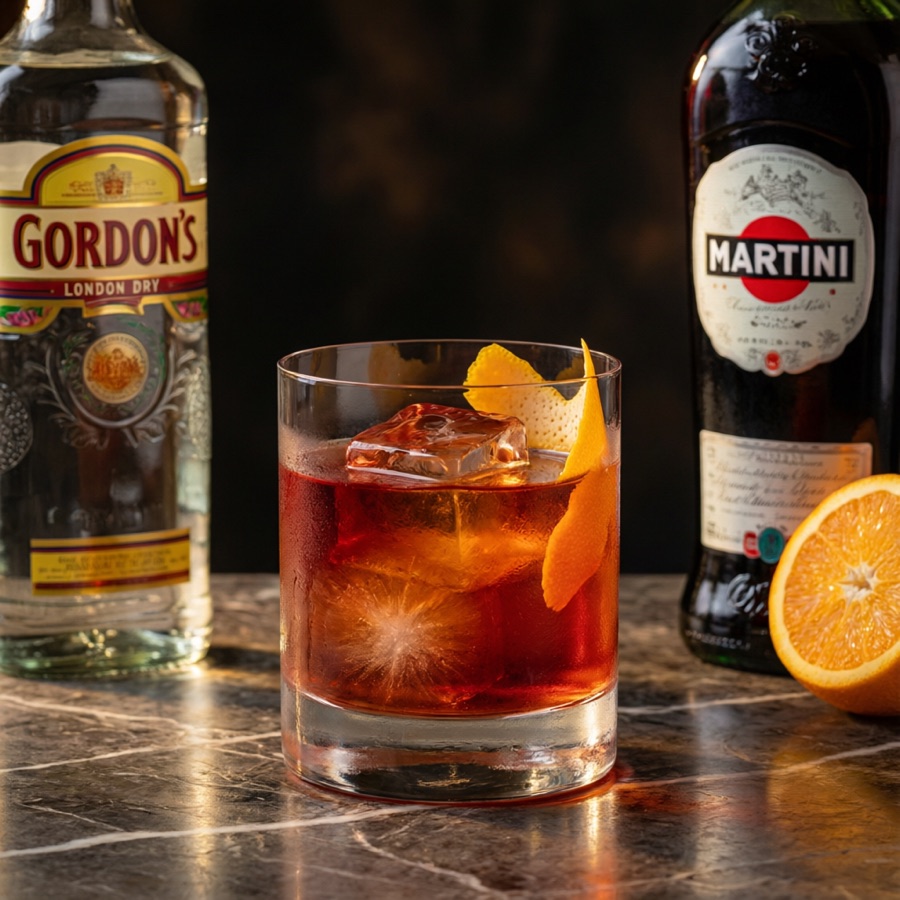
The Negroni's difficulty lies not in technique but in selection and temperature. Campari is the bitter anchor — the 25% Italian bitter sets the drink's ruby color and its bittersweet keynote through sharp orange and herbal notes. Sweet vermouth is the bridge: its sugar and spice soften Campari's edge while its wine acidity keeps the drink bright. Gin is the skeleton: juniper and botanicals lift the whole thing above mere "bitter syrup and wine." Equal 30-ml parts is the balance point a century of service has verified — bitter never bulldozes sweet, strength never swallows aroma. Adjustments follow clear logic: raise the gin to 45 ml (the 1.5:1:1 many modern bars run) for a drier, stiffer drink, or choose a richer vermouth for a rounder texture. Stirring parameters: plenty of large ice, 25–30 revolutions, a serving temperature of 0–4 °C, roughly 20% dilution; strain over one large cube in a rocks glass and express orange-peel oil across the surface — that oil is the formula's unwritten fourth ingredient, never to be skipped. On bottle selection, only gin at 43% or above survives the dilution; and vermouth is all about freshness — anything open for more than two months should be replaced.
3. Variation One: The Sbagliato and the Lower-Proof Logic
At Milan's Bar Basso in 1972, bartender Mirko Stocchetto reached for sparkling wine instead of gin. "Sbagliato" means "wrong," and the mistake made history: the bubbles stretch the body, the ABV falls from the mid-twenties to barely above ten percent, the bittersweet frame survives intact, and the drinking pressure drops dramatically — which is precisely why the Sbagliato detonated worldwide again after 2022. Build notes: use a dry sparkling wine, pour it last, stir gently at most, and keep the glass full of ice; if the bitterness feels sharp, trim the Campari slightly, but remove it entirely and you are left with sparkling sugar water. The Sbagliato proves the point: what binds the Negroni family together is not the gin but the bittersweet structure.
4. Variation Two: The White Negroni and Base-Spirit Swaps
The White Negroni arrived in 2001 from British bartender Wayne Collins: gentian liqueur Suze stands in for Campari, Lillet Blanc for sweet vermouth. The drink turns pale gold; the bitterness shifts from burnt orange to fresh herbal, and the aroma opens toward florals and citrus — a summer answer to the classic. The other direction swaps the base spirit: smoky mezcal creates the Mezcal Negroni, while bourbon creates the Boulevardier — in effect the Negroni's Prohibition-era cousin, best built at a 1:1.5:1.5 tilt so the whiskey can stand. Every variation obeys the same rule: keep the bittersweet frame, change only the personality of the corners.
5. Common Mistakes and Practical Advice
Mistake one: blaming Campari when a Negroni tastes "too sweet" — the culprit is usually oxidized vermouth, which degrades within weeks unrefrigerated; store it cold and finish it within 4–6 weeks of opening. Mistake two: under-stirring to "keep the strength" — insufficient stirring leaves the drink warm and ragged; dilution itself is part of the formula. Mistake three: swapping Aperol for Campari and expecting the classic — Aperol is lower in bitterness and higher in sugar, and the result is a visibly softer drink; for the classic face, Campari is the constant. Three drills for beginners: first, build the equal-parts benchmark and memorize its taste; then raise the gin to 1.5 parts and compare the structure; finally, express the orange oil and nose the drink before you sip. One Negroni and three variations — and the entire logic of bittersweet balance is yours.
More tips
274 cocktail recipes, one tap away
Browse by base spirit, flavor and strength. Save your favorites.
Open MixMyth