The Mixing Glass: Structure, Materials and the Logic of Stirred Cocktails
The Mixing Glass: A Complete Guide to Structure, Materials and the Logic of Stirred Cocktails
1. The role of the mixing glass: the vessel at the heart of stirring
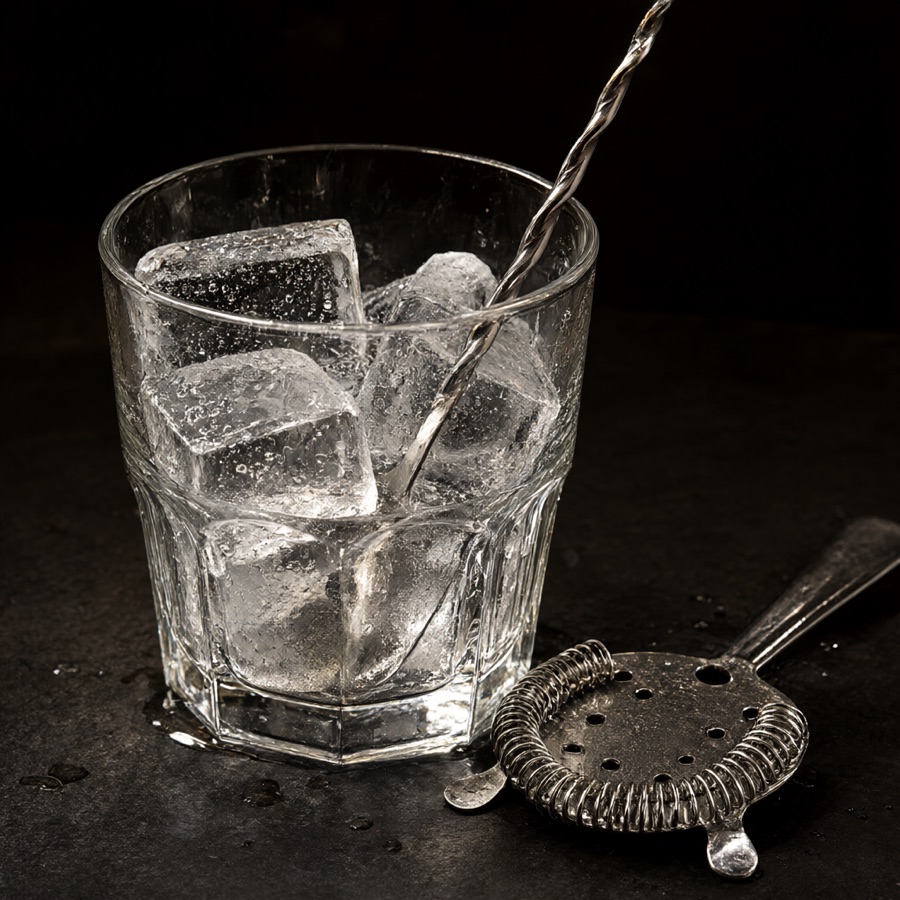
A mixing glass is an open vessel designed specifically for the stirring method. Unlike a lidded shaker, it does not chase violent mixing or rapid chilling; instead it offers a wide mouth and free space for a bar spoon to trace circles along the wall, folding spirit, vermouth and ice together in gentle convection. All-spirit recipes such as the Manhattan, the Martini and the Negroni are stirred rather than shaken precisely to preserve a clear body and a silky texture, because shaking drives in air and causes emulsification, clouding a drink that should be brilliant. Every design decision in the mixing glass serves those three goals: gentle, controlled and clear.
2. The materials debate: glass, metal and heat transfer
Stirring vessels come in two main materials. A glass mixing glass is heavy and transparent, and its great advantage is visibility: you can watch the ice melt, see the vortex and any layering, and admire the clarity of the finished drink, which makes it the traditional choice for bar counters and home display; its downsides are slower heat transfer, higher thermal mass and fragility. A metal stirring tin, usually silver-plated or stainless steel, conducts heat fast, resists breaking and is light, so high-volume professional bars favour it for chilling efficiency; the trade-off is that you cannot see inside. The glass half of a Boston shaker can also double as a mixing glass: pull it out on its own, fit a Hawthorne strainer and stir, a common money-saving trick among bartenders.
3. Capacity, shape and the pour spout
Capacity is the first parameter when buying. For home use and single serves, 500 to 650 ml comfortably holds one recipe of liquid plus a generous measure of ice; if you like to stir two drinks at once, choose 700 ml or more so the ice is not cramped and dilution stays even. In terms of shape, the body should be tall enough for the twisted handle of the bar spoon to circle the wall smoothly without splashing, and the base should be thick for stability and to slow heat ingress from the hand. The pour spout is the key detail on a glass mixing glass: a clean lip lets the liquid flow out in a steady ribbon alongside the strainer without dripping, whereas a straight-sided beaker relies more on wrist control.
4. How it pairs with strainers and the Boston shaker
A mixing glass has no built-in straining, so service always requires a strainer. Stirred cocktails most often use a Hawthorne strainer, whose spring coil seats against the rim to hold back ice and shards; for an even smoother mouthfeel, add a Julep strainer or a fine mesh for a double strain that catches fine ice crystals. With a metal stirring tin, the usual partner is a second tin, and the two are married into a Boston shaker so that one set of tools handles both shaking and stirring. Understanding this pairing makes it clear why stirring is not a careless swirl: it is a precise action coordinated across three tools, the vessel, the bar spoon and the strainer.
5. Buying, care and common mistakes
When buying, a beginner should start with a thick-based glass mixing glass with a pour spout, around 600 ml, which balances visibility and value; add a metal stirring tin later if you want faster service. For care, avoid sudden temperature swings that can crack glass, and never bang the bar spoon hard against the wall while stirring. There are three common mistakes. First, too little ice: with insufficient contact area neither chilling nor dilution is adequate, so the ice should submerge the liquid. Second, stirring by feel alone; a Manhattan needs roughly 20 to 30 seconds, while a Martini, aiming colder and more diluted, can take 30 to 40, so judge by target temperature and dilution. Third, not straining promptly after stirring, which lets the drink keep watering down in the glass and ruins the balance you just achieved. Master the mixing glass and you master half of the clear, classic bar.
More tips
334 cocktail recipes, one tap away
Browse by base spirit, flavor and strength. Save your favorites.
Open MixMyth