The Martini Family: How Garnish Defines a Drink
The Martini's Structure: The Fewest Ingredients, the Most Variables
A Martini (/recipe/1/) is minimal by recipe: gin and dry vermouth, stirred with ice and strained straight up. But minimal does not mean simple — when only two ingredients remain, every variable's weight is magnified. The gin-to-vermouth ratio, stirring time and temperature, the choice of garnish: change any one and you rewrite what the drink says. That is why the Martini is the touchstone of bartending — there is nowhere to hide, and it measures a maker's control over detail.
Standard Parameters for the Base
Classic ratios run between 4:1 and 6:1 (gin to dry vermouth). At 4:1 the vermouth's florals and roundness remain present, giving a softer mouthfeel; at 6:1 the drink approaches pure gin — dry and blade-like. Schools differ on technique: traditionalists measure the vermouth into the mixing glass; the extra-dry school rinses the glass with vermouth and dumps it, leaving only a film of aroma. Whatever the school, two hard rules hold: keep everything cold, stirring around thirty seconds until the vessel frosts; and the finished drink must be free of ice chips and haze (unless haze is the intent). Swap in vodka and you have the Vodka Martini (/recipe/2/) — more neutral, cleaner, a parallel track.
The Gibson: One Onion Rewrites the Drink
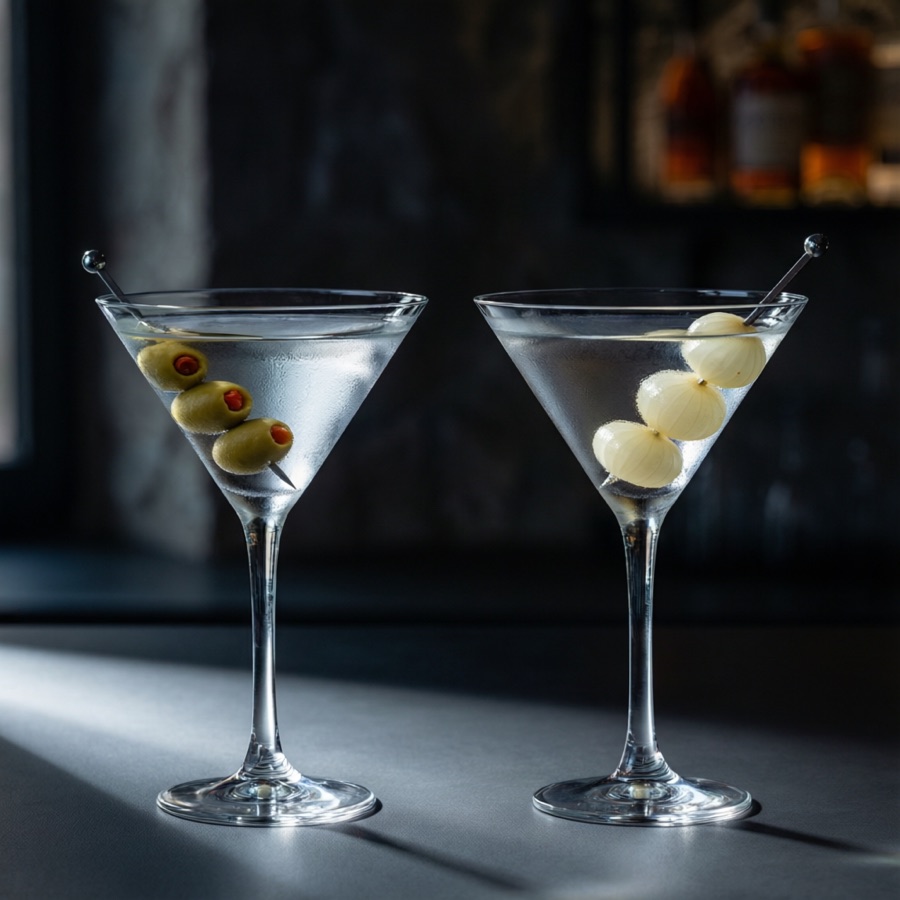
The Gibson uses the identical base; the only difference is garnish — a pickled cocktail onion. But in a drink this minimal, garnish is not decoration, it is a flavor participant. Steeping in the liquid, the pickling brine's vinegar, savoriness and faint sweetness bleed into the first sips and pull the whole drink toward an umami direction. The same mechanics explain the Martini's own two garnishes: an olive contributes brine and oiliness; a lemon twist, expressed over the surface, settles a film of citrus oils on top of the drink. Three garnishes, three personalities: lemon is brightest, olive roundest, onion sharpest. The "difference" between Martini and Gibson is effectively a live demonstration of how garnish diffuses flavor.
Other Branches of the Family
Following the logic of "change a garnish, change a variable," the family branches out: the Dirty Martini adds olive brine to the base itself, elevating brine from accent to structure; the Vesper (/recipe/210/) follows the 007 novel's original spec — gin, vodka and Lillet Blanc — a rare case of literature writing itself into a recipe; soju Martinis swap in Korean soju for part of the gin, a modern low-alcohol adaptation. Together these variants show that the Martini is not a fixed recipe but an open structure built on "strong spirit + dry aromatizer," with garnish and trace variables as its extension interface.
Three Points for Home Execution
First, vermouth must be fresh — a bottle open for over two months in the fridge turns a Martini sour, and this is the most common home failure. Second, freeze the coupe or martini glass ahead; the frost on the glass is half the experience. Third, keep garnish restrained: one olive, one onion, or one twist. Over-garnishing crowds out the drink's own voice and violates its aesthetic.
Source: MixMyth mixmyth.com
More tips

274 cocktail recipes, one tap away
Browse by base spirit, flavor and strength. Save your favorites.
Open MixMyth