The Complete Liqueur Guide: Flavor Families, Buying Logic and Mixing Applications
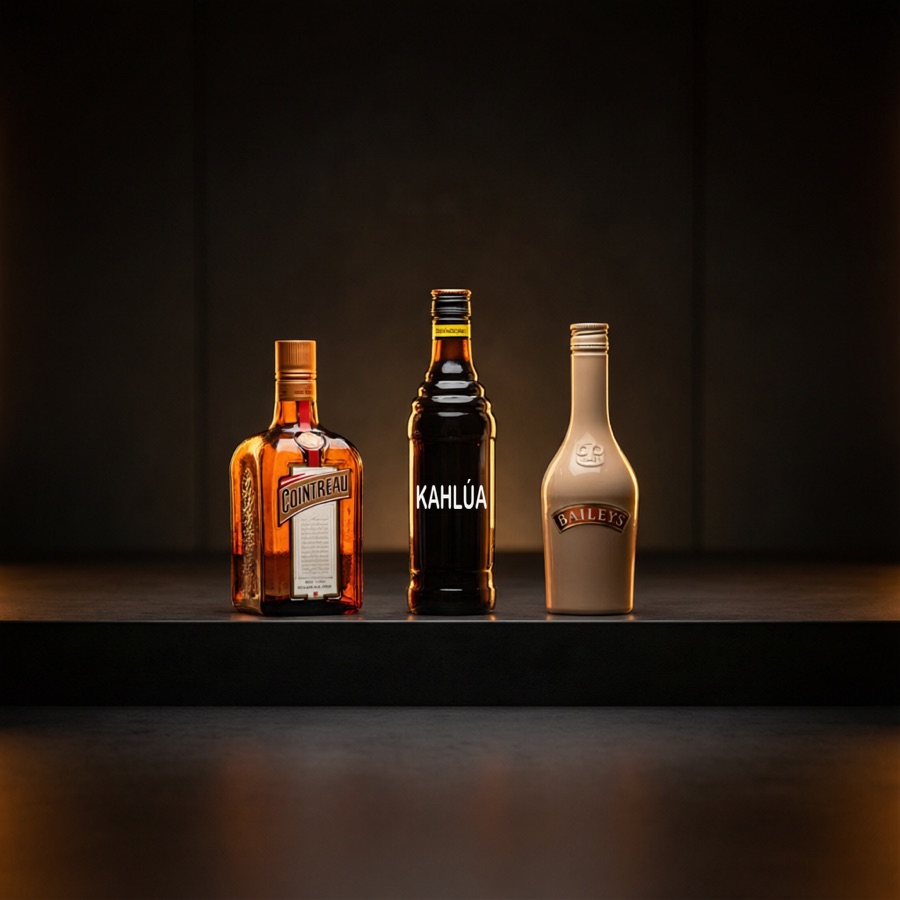
If base spirits are the skeleton of a cocktail, liqueurs are its flesh and expression. Built on a spirit base, they draw flavor from fruit, herbs, nuts, spices or cream through maceration, distillation or blending — and nearly all of them are sweetened. A Margarita cannot exist without Cointreau, an Espresso Martini without Kahlúa, and half of a Negroni's soul belongs to Campari. Understanding liqueurs is the watershed between reading recipes and writing your own.
How Liqueurs Are Made
There are three main production routes. Maceration soaks raw ingredients directly in the base spirit, extracting flavor and color over time — Campari's deep red bitterness comes from exactly this. Percolation pushes hot vapor or solvent through the botanicals to capture their essence, a route favored by many fruit liqueurs. Distillation co-distills the ingredients with the spirit, yielding a cleaner, purer aroma; Cointreau is the classic example. Almost every liqueur is sweetened after extraction — the EU floor sits around one hundred grams of sugar per liter — which is why liqueurs play a double role in a recipe: flavor source and sweetness source at once. Swap or omit one, and you must rebalance the sweetness of the whole drink, or the result turns either thin or cloying.
The Flavor-Family Map
By dominant flavor, common liqueurs fall into five families. The citrus family is the most used: triple sec and Cointreau ride on orange-peel oil, dry and bright, underpinning the Margarita, Cosmopolitan and White Lady; curaçao comes in white and blue, the blue version supplying the signature hue of party drinks such as the Blue Lagoon. The coffee-and-nut family carries the dessert register: Kahlúa anchors the Espresso Martini and both Russians, while Disaronno's almond defines the Godfather and Amaretto Sour. The herbal-bitter family is the backbone of aperitivi: Campari's sharp bitterness structures the Negroni and Americano; green and yellow Chartreuse, blended from over a hundred botanicals, can redirect an entire drink in small doses — the Last Word and Jungle Bird depend on it. The berry-and-floral family is the hottest of recent years: Chambord's blackberry lifts the French Martini, and St-Germain's elderflower gave the Gin & Tonic a new face. The cream family, led by Baileys, is dense and soothing, mostly served after dinner or in hot drinks.
The Three Jobs a Liqueur Plays
In classic recipes, a liqueur holds one of three jobs. The first is the bridge: in a Margarita, Cointreau connects the agave's vegetal edge with the sharp acidity of lime, making two angular ingredients shake hands. The second is the co-star: in a Negroni, Campari shares the stage equally with vermouth and the base spirit — the entire bittersweet skeleton rests on it, and swapping it turns the drink into something else entirely. The third is the accent: green Chartreuse occupies only a quarter part in the Last Word, yet it delivers the most recognizable herbal finish. Identifying a liqueur's job in a recipe decides whether you may touch it — bridges can be swapped within the same family, accents adjusted with care, and co-stars should rarely be recast.
Buying Logic: Usage First, Specs Second
A home bar needs no full shelf — build it in three tiers. Tier one is the high-frequency classic: one bottle of triple sec or Cointreau covers the Margarita, Cosmopolitan, Sidecar and more. Tier two follows your palate: Kahlúa for coffee lovers, Campari for herbal bitters, Chambord or St-Germain for fruit and flowers. Tier three is for curiosity. When buying, check three specs: ABV — most liqueurs sit between fifteen and forty proof-percent, and higher keeps longer; sugar content — the sweeter it is, the more syrup you should cut from the recipe; and bottle size — opened liqueurs fade slowly, so 500 ml usually beats one liter.
Mixing: Dosing, Substituting, Storing
In classic recipes liqueurs usually occupy ten to twenty milliliters — seasoning, not protagonist; overdose and the drink turns sweet and unfocused. Substitute within the same family: no Cointreau? Use triple sec and trim the syrup slightly. No Kahlúa? Cold-brew coffee with a little syrup works in a pinch, though you must calibrate the intensity yourself. Store opened bottles upright, away from light: cream liqueurs like Baileys belong in the fridge and should be finished within six months; high-sugar bottles like Cointreau and Campari are fine at room temperature, but wipe the neck clean to prevent crystallization and cross-contamination. One last warning: color is not flavor intensity — blue curaçao's orange note is quite gentle, so never let the color dictate your dose.
More tips
274 cocktail recipes, one tap away
Browse by base spirit, flavor and strength. Save your favorites.
Open MixMyth