Layering & Floating: The Density Science Behind Layered Cocktails
Layering & Floating: The Density Science Behind Layered Cocktails
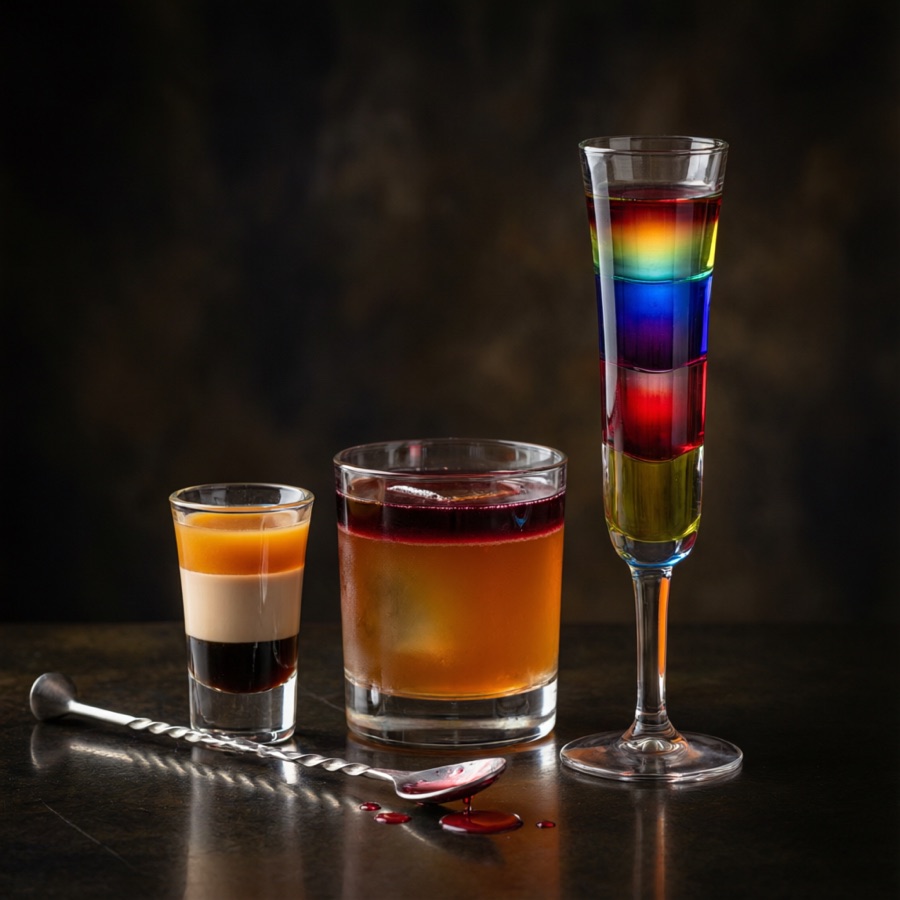
A B-52 shot stacks coffee liqueur, Irish cream and orange liqueur into three razor-straight bands; a New York Sour wears a ruby crown of red wine over its amber body. Neither is video magic. Both rest on a foundational bar skill - layering - and layering runs on exactly one physical quantity: density. No special equipment, no molecular additives, just physics you can pour.
Density Decides What Floats
Whether two liquids form a clean boundary comes down to their density difference, and the rule compresses into one sentence: sugar makes a liquid heavier, alcohol makes it lighter. Water sits around 1.00, pure ethanol about 0.79, while a heavily sweetened syrup can push past 1.15. That gives the first law of layering - pour bottom to top in order of decreasing sugar and increasing strength. In a B-52 the sweetest coffee liqueur anchors the base, Irish cream sits in the middle, and the stronger orange liqueur floats on top; reverse the order and the tiers collapse. The same logic holds the red-wine float on a New York Sour: the shaken sour is denser than the dry red, so the wine spreads into a layer instead of sinking. Temperature also nudges density: colder liquids are denser, so chilled bottles form cleaner boundaries - which is why seasoned bartenders refrigerate everything before a layered service.
Reading Density Clues From the Bottle
You do not need to memorize density tables, only the rough ordering: thick syrups such as grenadine sit below cream liqueurs, cream liqueurs below fruit liqueurs, fruit liqueurs below straight spirits. Two details matter. First, when sugar levels are close, the higher-proof bottle floats - among liqueurs of similar sweetness, the drier one rides higher. Second, fruit juices contain sugar but stay near water in density, so they still sink beneath spirits. When inventing a combination, turn the bottle over: high sugar with under 20% ABV almost guarantees a base layer. The most direct density test is a small trial stack in a measuring glass with a straw - confirm the order there before committing it to the real glass.
The Spoon-Back Pour, Step by Step
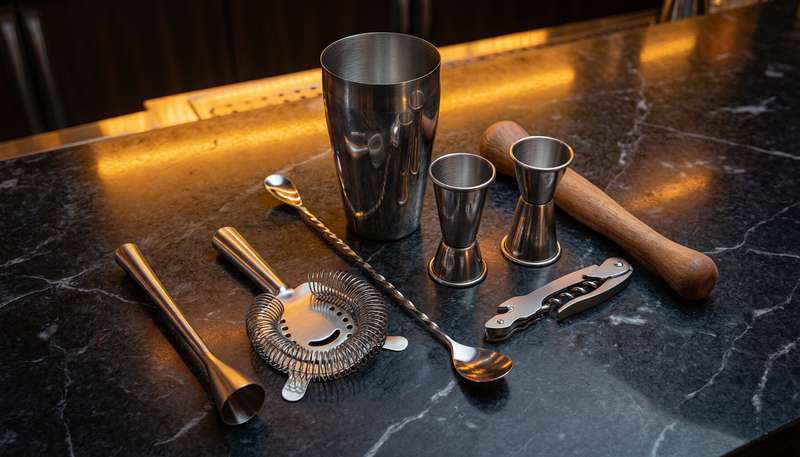
Step one: pour the base layer and fill the glass with ice - the ice is a natural buffer that absorbs the fall of the next layer. Step two: hold a bar spoon convex side up, its back resting against the glass wall just above the liquid. Step three: pour the next layer slowly over the back of the spoon so it slides down the wall and spreads, rather than plunging into the center of the surface. The whole movement has one keyword - slow. A thinner stream means a cleaner boundary; if a layer breaks, stop, let the glass settle, then continue. For a red-wine float, throttle the stream to a thread and start close to the surface to paint the full sunset layer. While practicing, a jigger poured against the spoon back gives measured control; once steady, switch to free-pouring from the bottle - the speed control lives in the wrist, not the arm. The vessel matters too: narrower openings are more forgiving, so master the shot glass before attempting floats in a wide rocks glass.
Where Layering Shows Up
Layering appears in three families. Pure layered shooters, led by the B-52: coffee liqueur, Irish cream and orange liqueur floated in sequence, served as a slammer or flamed. Floats over sours, such as the red-wine crown of a New York Sour or the whiskey cap on a Dublin Mist - the float is the garnish of flavor, so taste the transition before you stir. And tall-drink gradients, where the principle runs in reverse: in a Tequila Sunrise, grenadine sinks on its own weight and paints the dawn.
Common Mistakes and Rescues
Pouring too fast is the number one failure - halve your flow rate again and the boundary snaps into focus. Wrong order is terminal: once the low-sugar liquid is down first, no heavier syrup will dive beneath it, so restart. Room-temperature liqueurs blend more easily than chilled ones, so pre-chill everything when the stakes are high. And if a drink mixes on you, shake it with ice - a layered cocktail becomes an ordinary shaken one, tasting just as good with less drama. Layering is a showpiece skill: drill it with inexpensive syrups and spirits until every pour lands, then open the good bottles. And a pseudo-failure: boundaries that stay sharp but look muddy usually mean the two layers are too close in sweetness - widen the sugar gap and the colors snap back.
More tips
274 cocktail recipes, one tap away
Browse by base spirit, flavor and strength. Save your favorites.
Open MixMyth