The Complete Guide to Jiggers: Sizes, Shapes and the Logic of Precise Measurement
The Complete Guide to Jiggers: Sizes, Shapes and the Logic of Precise Measurement
In the world of cocktails, the most underrated tool is rarely the shaker - it is the jigger. A cocktail's balance rests on the ratios between its ingredients, and the jigger is the only instrument that turns those ratios into quantities. This guide covers shapes, size systems and working habits, and explains how to choose and use your first jigger properly.
1. Why Measurement Is the Precondition of Balance
The skeleton of every classic cocktail is a set of ratios: sours run roughly spirit : sour : sweet at 4 : 2 : 1, the Negroni is 1 : 1 : 1 and the Margarita 2 : 1 : 1. Shift the ratio and the flavor collapses. Take the Whiskey Sour: 5 ml extra lemon juice turns the drink sharp and mean; 5 ml extra syrup buries the whiskey's aroma. Long drinks are no different: in a highball the spirit-to-soda ratio sets the strength, in a Collins the sweet-sour balance sets the first impression - all of these "feelings" must ultimately become numbers. The human hand has no reliable feel for 5 ml - the difference between a full and a half pour from a bottle is far larger than you think. In the same drink, a 3 ml deviation of lemon juice may pass unnoticed, but by the third glass the guest senses the inconsistency; a bar sells not one good drink but the promise that every drink is good. This is why professional bars insist on measuring every drink: what is being measured is reproducibility. A drink that is great today and mediocre tomorrow is not a product. The word "jigger" itself comes from the small cups used to ration spirits aboard British sailing ships - from its birth, its mission has been to fix the portion.
2. The Main Shapes: Japanese, French and American
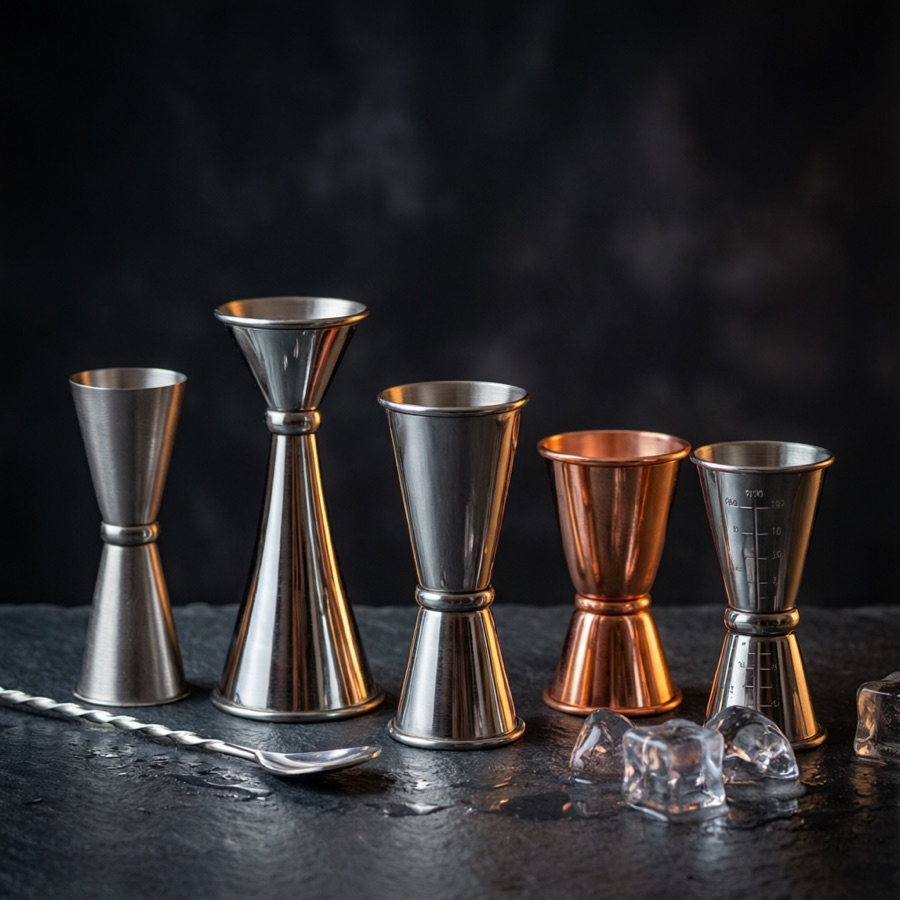
Three shapes dominate the market. The Japanese-style double jigger is tall and conical with a narrow mouth; the pour gathers cleanly and spills less, which is why it is the mainstream choice on Asian bars, commonly in 30/45 ml or 15/30 ml. The French bell jigger has a wider body and a lower center of gravity; it sits steady in the hand and is common in European bars. The classic American hourglass jigger is short and wide-mouthed - fast to pour, but beginners tend to spill when flipping the wrist. In materials, 304 stainless steel is the baseline; copper and titanium plating are mostly about looks and feel. More worth checking: is the weld ring solid, is the rim smooth, and can it stand upright on the bar top. The double-ended design is not redundant: the large end measures the base spirit, the small end the modifiers, and one flip of the wrist completes two measures without breaking rhythm - which is why the double-ended cup became the mainstream, while single-ended cups serve large or special capacities.
3. Size Systems: Ounces, Millilitres and Graduations
The imperial system counts in ounces (1 oz ≈ 30 ml); the metric system in millilitres. When buying, look first at the two-end capacity pairing: 15/30 ml covers the most common small measures (lemon juice, syrup, liqueurs), 30/45 ml covers base spirits, and 22.5/45 ml is the ounce-system equivalent. Memorize a few conversions and most recipes open up: 0.5 oz = 15 ml, 0.75 oz = 22.5 ml, 1 oz = 30 ml, 1.5 oz = 45 ml, 2 oz = 60 ml; the reason 22.5 and 45 appear so often in classics is precisely that they are three-quarters and one-and-a-half of an ounce. Graduations come etched on the inner wall or printed on the outside; the former lasts longer. Beginners should pick a model with intermediate marks (10/20 ml or 7.5/15 ml). Avoid ungraduated single large cups - the moment you need 15 ml, you will have no way to measure it.
4. The Boundary Between Free Pouring and Measured Pouring
The free pour that seasoned bartenders perform in front of guests relies on the flow rate of a pour spout plus a counted rhythm; it is a skill that demands long training and regular calibration. Even so, precision-minded bars still measure base spirits with a jigger and free pour only mixers like soda and cola. Some bars run a hybrid: base spirits and liqueurs measured, citrus measured, only the sodas free poured - a compromise between efficiency and stability, and a tiered strategy worth borrowing at home. If you want to learn free pouring, start with calibration: fit a pour spout, pour water to a counted beat, then check it against a jigger or measuring cup, and repeat until the error is within 3 ml before touching real spirits. Uncalibrated feel is an illusion. For the home enthusiast there is only one piece of advice: measure everything. Free pouring saves two seconds and costs the stability of the whole drink - terrible value.
5. Selection Advice and Common Mistakes
For a first jigger, a 15/30 ml Japanese double cone is enough; if the budget allows, add a 30/60 ml for larger recipes. Three common mistakes: buying cheap plastic cups whose capacity is wrong; assuming bigger is better, when a large cup measuring a small amount has enormous error; and neglecting cleaning, so syrup films the wall and taints the next pour. Care is simple: rinse in warm water after use and dry upside down, brush syrup out of the graduations with a soft brush, and keep steel wool away from plated models. The jigger is the cheapest professional threshold on the bar - a few dollars buys certainty in every glass. It measures ratios, and a bar's most basic respect for ratios; once the habit of measuring is formed, the floor of every drink you make is already higher than most.
More tips
274 cocktail recipes, one tap away
Browse by base spirit, flavor and strength. Save your favorites.
Open MixMyth