The Japanese Bartending School: Hard Shake, Ice Carving and Artisan Precision
The Japanese Bartending School: Hard Shake, Ice Carving and Artisan Precision
Japanese bartending is often misread as a mere "style"; in truth it is an entire technical system built on precision and restraint. Imported from European classic bar culture in the early twentieth century and refined over generations of Japanese bartenders, it imposes extreme control over temperature, dilution, aeration and texture. To understand this school is not to imitate flashy shaker moves, but to grasp the physics and the artisan methodology underneath.
Origins: A Foreign Craft Rebuilt at Home
The root of modern Japanese bartending lies in the Western-style bars that opened in Tokyo and Yokohama in the early twentieth century. A first generation of masters brought European recipes and techniques home, then spent decades polishing them, stripping away Western casualness and injecting the Japanese craft tradition's devotion to "kata" (form) and "ma" (interval). Kata is the standardized movement pattern; ma is rhythm and proportion. It is precisely this attitude - treating every pour as a reproducible craft - that earned Japanese bartending its global reputation for precision. It does not chase novelty in recipes; it chases a flawless Martini, a flawless Highball.
The Hard Shake: Forcing Air into the Body
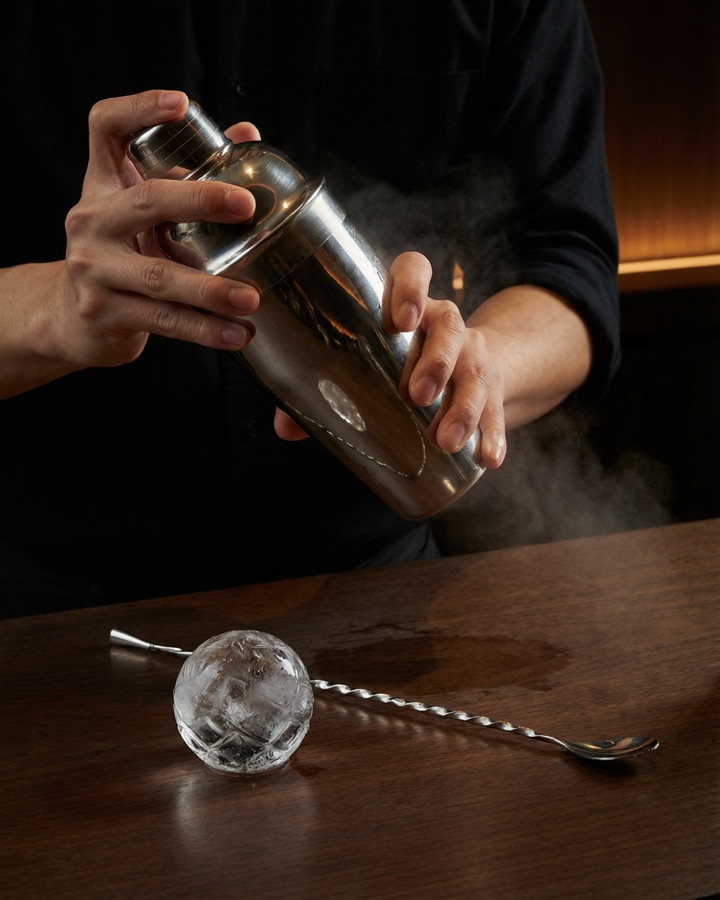
The Hard Shake is the school's most famous technique. It is not simply shaking harder; it uses a specific wrist trajectory that sends the ice spinning along a three-dimensional arc inside the tin, colliding and folding a dense cloud of fine air into the liquid. Its physical effects are threefold. First, rapid chilling, which shortens shake time and limits over-dilution. Second, the micro-bubbles give a silkier, softer mouthfeel, ideal for sours carrying citrus and syrup. Third, the surface forms a fine, persistent foam. The key is to "flick" rather than "push" - the wrist stays loose yet explosive, letting the ice tumble freely instead of packing tight. Japanese bars favor the heavier three-piece cobbler shaker precisely because its mass stores greater centrifugal inertia along the fast arc, making the ice collide harder and the aeration more even. Note that the hard shake is not universal: for clarified, spirit-forward recipes best served stirred, over-aeration destroys their silky texture.
The Philosophy of Ice: Hand-Carved Spheres and Temperature Control
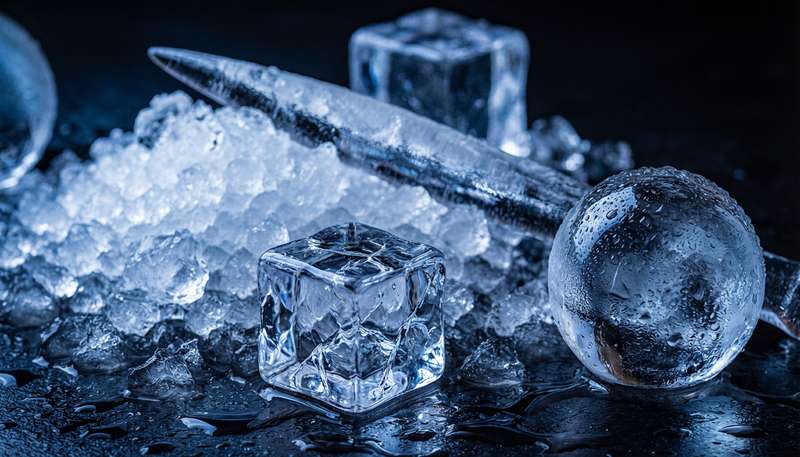
The Japanese bar treats ice with near-obsessive care. Cubes must be fully clear, bubble-free and odorless - old ice, made by controlling freeze rate or cutting from a solid block to purge trapped air and impurities. Hand-carved ice spheres are the signature presentation: the bartender chips a square block facet by facet into a sphere or polyhedron. This is theater, but also physics - a sphere has the smallest surface-to-volume ratio, so it melts slower and dilutes more controllably, and its rounded edges will not scar the glass. The same logic governs stirring and building: the larger, colder and harder the ice, the slower the dilution and the better the drink holds its structure; the thin ice of a home freezer melts far too fast and can water a drink down within a minute, which is why Japanese bars often temper their ice up toward zero degrees to shrink the temperature gap before use. Grasping that "ice is an ingredient, not a filler" is the first step into the school.
The Bar Spoon and the Stir: Silent Precision
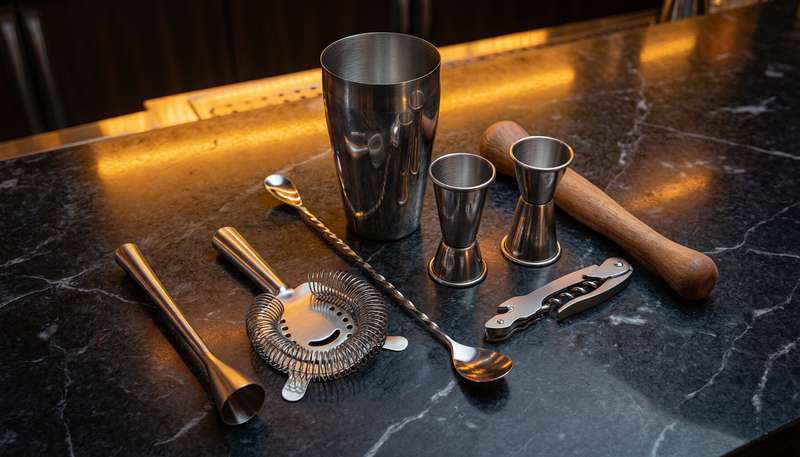
The Japanese stir pursues absolute uniformity with minimal aeration. The bar spoon's twisted stem is not decoration; it is an ergonomic guide that lets the fingers rotate on a fixed path so the back of the spoon glides along the glass wall in a smooth circle. While stirring, the ice should rotate as one mass along the wall rather than being churned apart, chilling and diluting the liquid evenly without trapping air. Many Japanese bartenders count exact turns and seconds, reproducing the same mouthfeel with stopwatch steadiness. All-spirit recipes like the Martini and the Manhattan are the finest stage for this craft.
Highball Culture and the Artisan Spirit
If the hard shake and ice carving are the "technique", then Highball culture embodies the "way". Japan turned a simple whiskey-and-soda into a national drink through obsessive control of every variable: the exact whiskey-to-soda ratio, a thoroughly chilled glass, maximum retention of soda carbonation, the right citrus-oil garnish. The order of operations matters just as much - whisky goes in over ice first with a light stir to chill, then soda is poured slowly down the back of the bar spoon and lifted only once, so the carbonation is never beaten out. Behind it sits the artisan spirit of omotenashi, wholehearted hospitality - doing the simplest thing supremely well is the deepest respect for the guest. The ultimate lesson of Japanese bartending is not a secret move but this attitude: temperature, dilution, aeration, texture - every variable deserves to be taken seriously. When you begin judging every drink in your hand against a reproducible craft standard, you are already standing inside the school's gate.
More tips
274 cocktail recipes, one tap away
Browse by base spirit, flavor and strength. Save your favorites.
Open MixMyth