The Italian Bitter Family: A Complete Guide to Amaro, Aperitivo and the Campari Lineage
The Italian Bitter Family: From Aperitivo Tradition to the Science of Bitterness
I. Aperitivo: The Social Origin of Bitter
Italian bitter culture is rooted in the aperitivo tradition. In the cafes of nineteenth-century Turin and Milan, diners opened the evening with a lightly bitter, low-proof drink; the bitterness stimulated saliva and gastric juices, waking the appetite and setting a relaxed tempo for the long dinner ahead. This functional origin fixed the register of Italian bitters: bitter but not harsh, sweet but not cloying, typically 11%-25% ABV, built for slow sipping alongside food rather than a single gulp. Campari was codified in Milan in 1860, its still-secret botanical recipe establishing the prototype of the red-orange bitter; Aperol arrived in Padua in 1919, pushing the aperitivo to the masses with lower proof and a sweeter outline. Together they set the visual and gustatory paradigm of the red-orange bitter and made bitterness the language of Italian table sociability. For this reason Italian bitters carry a double identity - social and aperient - which explains why they are rarely drunk neat to the bottom but always meet sparkling wine, juice or spirit, completing a second life in the glass.
II. Lineage: The Aperitivo / Amaro Divide
Italian bitters split into two branches by sweetness, bitterness and occasion. The aperitivo branch (Campari, Aperol, Select) is defined by bright fruit and moderate bitterness, red-orange in colour, aimed at pre-dinner opening and sparkling builds - the backbone of the Spritz and of long American-style drinks. The amaro branch (amaro meaning "bitter") leans into herbal depth and post-dinner digestion: higher bitterness, fuller body, commonly 30%-40% ABV, with Montenegro, Averna, Braulio, Nonino and Cynar as standard-bearers. Fernet is the extreme edge of amaro - fiercely bitter, barely sweetened, mint and saffron forward, often above 40% ABV - the bartender's heavy hammer of bitterness. Reading this sweet-to-bitter spectrum is the first lesson in understanding the whole Italian bitter family.
III. The Structure of Bitter: Botanicals, Sugar, Alcohol
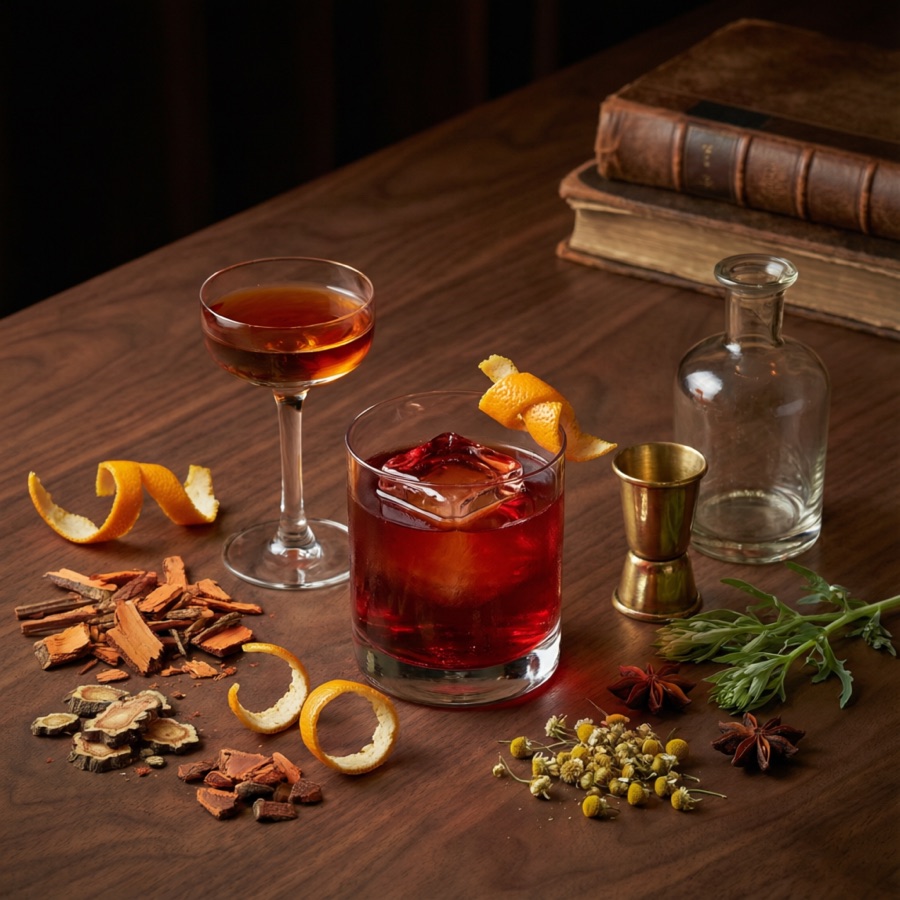
A bitter's flavour is set by the balance of three inputs. Bitterness comes from botanical maceration: cinchona bark gives a quinine-like dry bitter, gentian root an earthy depth, wormwood and rhubarb root herbal and sour bitterness, and artichoke (the heart of Cynar) a vegetal clarity. Sweetness arrives as syrup or caramel to round the bitter edge and extend the finish. Alcohol is both extraction solvent and body. Proportion defines personality: Campari sits near a fifty-fifty bitter-sweet split, tightly structured; Aperol runs sweeter and gentler on the palate; Fernet removes the sweet corner almost entirely and pushes bitterness to the front. Understand this triangle and you can predict how an unfamiliar amaro will behave in a glass without opening the bottle - read the sweet-bitter ratio, read the ABV, read the dominant botanical, and the character reveals itself. In other words, a bitter is not a "tool for adding bitterness" but a pre-balanced bitter-sweet system; the bartender's job is to place it at the right coordinate, not to rebuild it.
IV. Classic Applications: From Negroni to Cardinale
In mixing, bitters carry the bitter-sweet axis - one of the few ingredients that supply bitterness, sweetness and aroma at once. Equal parts gin, Campari and sweet vermouth make a Negroni, a three-way balance of bitter, sweet and strength; swap the gin for sparkling wine and it becomes a Negroni Sbagliato, lighter in body and brighter with bubbles; replace sweet vermouth with dry and raise the gin proportion and you arrive at the drier, sharper Cardinale. Aperol, low in bitterness and proof, is the soul of the Spritz, joining prosecco and soda as the standard answer of an Italian summer. Amaro often enters as a float or a sweet-vermouth substitute, lending an herbal finish and complexity to stirred drinks. Fernet is dosed in dashes, injecting medicinal depth into a Manhattan or an Old Fashioned. When substituting, hold to one iron rule: the bitterer the bottle, the more restraint the pour demands - better to under-dose and adjust than to over-pour once.
V. Buying, Storing and Pairing Logic
Begin with Campari and Aperol: one bottle covers stirred drinks, one covers sparkling, together replicating the core canon of Negroni, Americano, Spritz and Cardinale. Then add a mid-bitterness amaro (Averna or Montenegro) to open up digestif and floating applications, and a bottle of Fernet to explore the extreme bitter edge. Once opened, bitters are relatively stable thanks to high sugar and alcohol, but botanical aromatics fade with oxidation - use within a year, store upright away from light; refrigeration slows flavour loss in amari. When buying, judge by bitter-sweet ratio and ABV rather than brand story - those two parameters decide whether a bottle integrates into the recipes you already make. When pairing, match bitterness to body: light base spirits suit low-bitter aperitivi, while only weighty bases can carry the mass of Fernet; a near fifty-fifty bitter-sweet bottle is the most versatile and makes the ideal first bitter for a home bar.
VI. Common Misconceptions and Corrections
First, treating bitters as liqueurs. Though they contain sugar, their core is a bitter structure; substituting an equal volume of a sweet liqueur such as Triple Sec collapses the balance and leaves only cloying sweetness. Second, ignoring oxidation. A Campari opened for a year has lost its orange lift, and a Negroni made with it tastes thin and flat - use it up promptly or decant into smaller bottles to reduce headspace. Third, brand worship. Bitter-sweet ratios vary enormously between amari; the "amaro" in a recipe is not a generic part, so read the label parameters before substituting rather than copying a name. Fourth, over-dosing Fernet. Its bitterness and herbal intensity are extreme - one dash sets the tone, three dashes ruin the glass - so always dose by the dash and taste a small trial before scaling up. Avoid these four traps and bitters stop being an unruly oddity, becoming instead the most reliable bitter-sweet axis in your recipe system.
More tips
274 cocktail recipes, one tap away
Browse by base spirit, flavor and strength. Save your favorites.
Open MixMyth