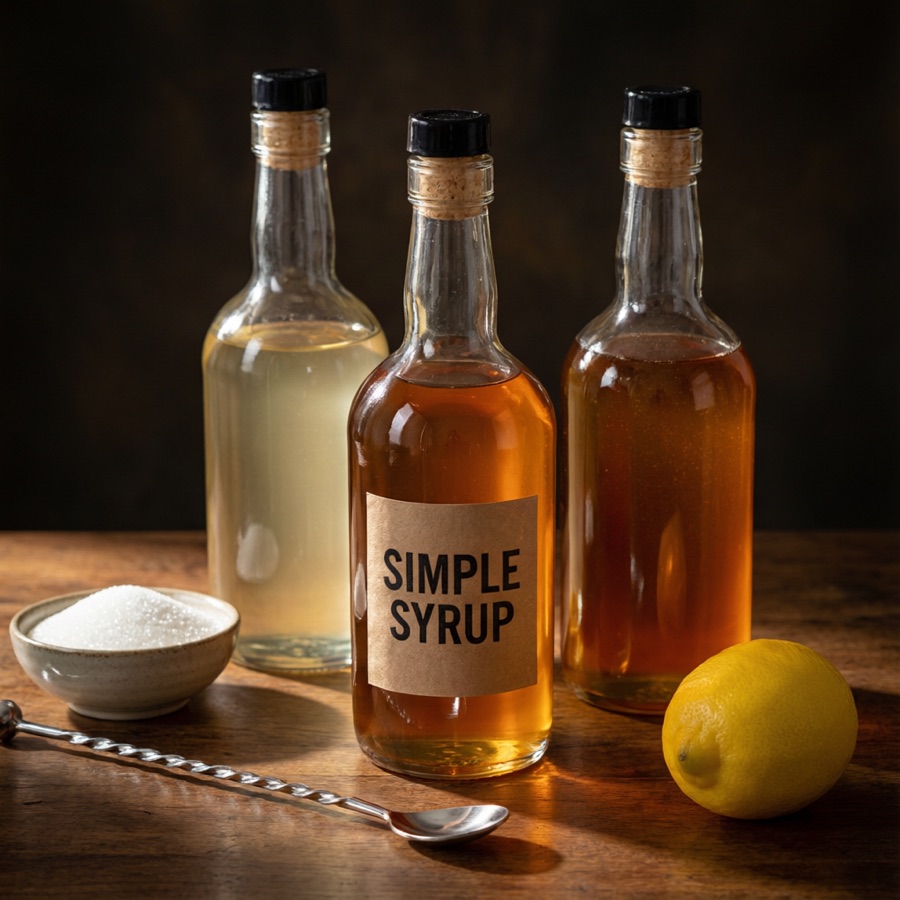
Homemade Cocktail Syrups: Ratios, Heat, and the Flavor Variables
Why Syrup Deserves Its Own Lesson
Granulated sugar dissolves painfully slowly in cold liquid — tossed into an iced shaker, it ends up as gritty sediment at the bottom of the glass. Syrup dissolves the sugar in advance so it integrates with spirits and citrus in seconds. More importantly, syrup is the easiest flavor variable to control: swap the syrup in the same recipe and the drink's personality visibly shifts. This lesson covers four targets: simple syrup, rich syrup, honey syrup, and flavored syrups.
Simple Syrup 1:1 — The Universal Starting Point
Combine white sugar and water 1:1 by weight, warm over low heat while stirring, and pull it off the moment the crystals dissolve and the liquid runs clear again. Heat control is the point: never let it boil. Boiling evaporates water (skewing the ratio) and yellows the syrup with bitter caramelized edges. A 1:1 syrup is moderately sweet and clean in texture — right for a Daiquiri or Whiskey Sour (/recipe/21/) where the base spirit's aroma should stay front and center. Bottled and refrigerated, it keeps two weeks.
Rich Syrup 2:1 — Body for the Old Fashioned
Two parts sugar to one part water, same method, more patience. The thick texture stands up to the high-proof base of an Old Fashioned (/recipe/41/) without being washed thin by melting ice — a proper Old Fashioned never muddles raw sugar; two teaspoons of rich syrup is the standard answer. It also contributes a light caramel roundness that flatters dark spirits. Refrigerated, it keeps a month or more.
Honey Syrup — Never Pour It Straight
Honey seizes in cold alcohol, clumping and clinging to the glass. The standard fix is diluting it 2:1 or 1:1 with warm water, depending on target sweetness. Honey syrup brings a rounded floral sweetness that pairs exceptionally with whiskey, lemon and ginger — the signature softness of the Penicillin comes from exactly this. Note that honey lightly veils delicate base aromas, so use it carefully in fine-boned gin drinks.
Flavored Syrups — One Variable, a Whole Product Line
Add one ingredient to a base syrup and a product line opens up: ginger syrup (fresh ginger sliced and simmered 20 minutes, then strained) is the soul of the Penicillin; cinnamon syrup is a natural with rum and hot drinks; demerara syrup, made from dark cane sugar, brings deep caramel notes to dark spirits. The general formula: 30-50 g of flavoring per 200 ml of 1:1 syrup, simmered 15-20 minutes, strained and bottled. Hard ingredients (ginger, cinnamon) need full simmering; delicate ones (mint, shiso) go in only off the heat, steeped without boiling, or they turn grassy.
Storage and Failure Modes
Every syrup goes into a sterilized glass bottle in the fridge: 1:1 keeps two weeks, 2:1 a month, flavored syrups about one week. Cloudiness, bubbles or a sour smell mean fermentation — dump it and start over. There are only two common failures: boiling the sugar until it yellows and turns bitter, and overcooking flavorings into astringency. Control the heat, and syrup becomes the most forgiving fundamental in home bartending.
Source: MixMyth mixmyth.com
More tips
274 cocktail recipes, one tap away
Browse by base spirit, flavor and strength. Save your favorites.
Open MixMyth