The Complete Gin Guide: From London Dry to New Western Botanicals — Flavor Taxonomy and Cocktail Applications
The Complete Gin Guide: From London Dry to New Western Botanicals — Flavor Taxonomy and Cocktail Applications
If the cocktail canon were a city, gin would be its main avenue: the Martini, the Negroni, the Gin & Tonic, the Gimlet and the Last Word all stand on a juniper backbone. Yet behind the word "gin" sits a family of spirits with wildly different personalities — the same recipe, built on a different style of gin, is effectively a different drink. Choosing the right style is step one of understanding gin.
1. What Makes Gin Gin: A Spirit Defined by Juniper
The definition is simple: a neutral grain spirit redistilled with juniper and other botanicals. Legally, the juniper must be perceptible — that is the line separating gin from flavored vodka. Tracing the lineage, gin descends from Dutch jenever — originally a medicinal juniper wine — which swept Britain after William III took the throne in the late 17th century; London's Gin Craze and the Gin Acts that followed forged the prototype of the modern spirit. Flavor arrives through two main routes: steeping the botanicals in the base spirit and redistilling (steep & redistill), which gives a fuller, denser profile; or passing the alcohol vapor through a botanical basket (vapor infusion), which yields something lighter and more aromatic. Most large producers use both, and the ratio defines the house style. Base spirit purity, the number of distillations and the order in which botanicals enter the still together form a gin's flavor fingerprint.
2. The Four Style Families
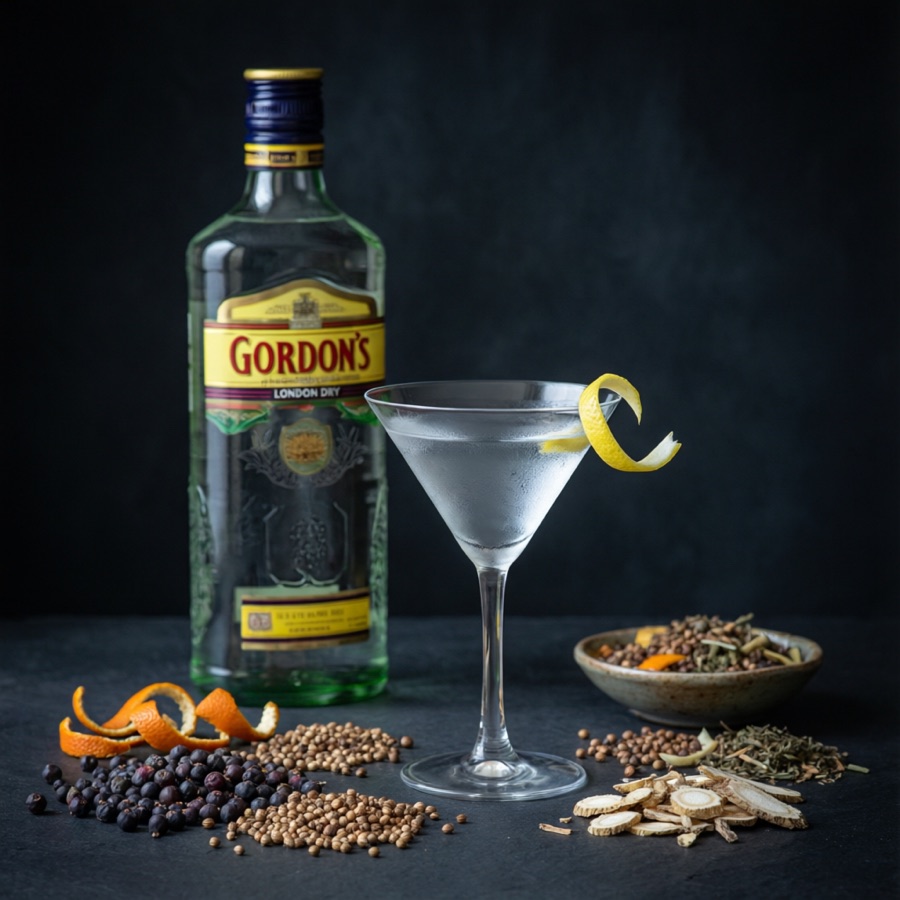
London Dry is the mainstream: every flavor must come from the distillation itself, nothing may be added afterward beyond a trace of sugar, and the result is juniper-forward and bone-dry. Gordon's, Tanqueray and Bombay Sapphire all belong here, and most classic recipes silently assume this style. Note that "London Dry" is a process standard, not a geography — it can be made anywhere. Plymouth, now down to a single distillery, is rounder and earthier with an orris-root softness; the earliest Martini formulas were built on it, and that softness rounds a Martini's edges. Old Tom is the sweetened gin of the 19th century — the original base of the Tom Collins and the Martinez — revived by the heritage movement for the modern bar; its sweetness is part of the recipe, so dial the syrup down accordingly. New Western (or Contemporary) gin demotes juniper to a supporting role and leads with florals, citrus or regional botanicals, giving modern drinks their aromatic signature — from Hendrick's cucumber-and-rose signature to the American regional-botanical school. Behind them all sits the ancestor: genever, the malt-wine-based Dutch spirit that is gin's prehistoric form and a study in its own right for the Martinez.
3. Flavor Variables: The Botanical Bill and the Proof
A gin's botanical bill runs from half a dozen to thirty-plus entries: coriander seed supplies a citrusy lift, angelica root anchors the body, orris root fixes the aroma, citrus peel brightens the top note, while cardamom and licorice shape the finish. Reading the botanical list on the label teaches more than reading the brand story. Proof matters just as much: the standard 40–43% suits builds and highballs; an export strength around 47% survives stirring and dilution; and 57% Navy Strength — historically the Royal Navy's proof test for gunpowder — is the amplifier for heavy hitters like the Negroni. A tasting protocol helps: nose the dry aroma first, then sip neat at room temperature, judging juniper persistence, citrus brightness and the cleanliness of the finish. A good mixing gin should read as structure, not as a blur of perfume.
4. Application: Match the Style to the Drink
For a dry Martini or a Gin & Tonic, pick a juniper-sharp London Dry for the cleanest structure. To rebuild the 19th-century Martinez or Tom Collins, let Old Tom's sweetness fill the historical gap. Floral recipes such as the Aviation or the Paper Plane gain their aromatic ceiling from a New Western gin. The Negroni demands a body that can punch through Campari and vermouth — start at 47% and up. And bitters-driven recipes like the Pegu Club are the truest test of a base gin's cleanliness. Working ratios to start from: a Gin & Tonic at 1:2 to 1:3 over a full glass of ice with a single gentle lift; a dry Martini at 60 ml of gin to 10 ml of dry vermouth, adjusted to taste. Swapping styles is never a mistake, but know exactly which variable of the recipe you are changing.
5. Buying and Common Misconceptions
A first bottle should be a standard London Dry such as Gordon's: the recipe baseline, cheap, stable and available everywhere. A second bottle at 47% covers the heavy recipes. Misconception one: gin tastes only of juniper — the botanical bill is the real flavor map. Misconception two: expensive means better for mixing — the subtlety of a boutique gin is usually erased by stirring and dilution. Misconception three: pink and flavored gins behave like classic gin; they follow liqueur logic, and their sweetness will wreck a balanced recipe. Store the bottle away from light and heat; the high proof keeps the flavor stable for a year or more. One closing exercise: build a Gin & Tonic, a Martini and a Negroni with the same bottle, and notice how ratio, temperature and dilution rewrite the gin — that is when you truly read the bottle.
More tips
274 cocktail recipes, one tap away
Browse by base spirit, flavor and strength. Save your favorites.
Open MixMyth