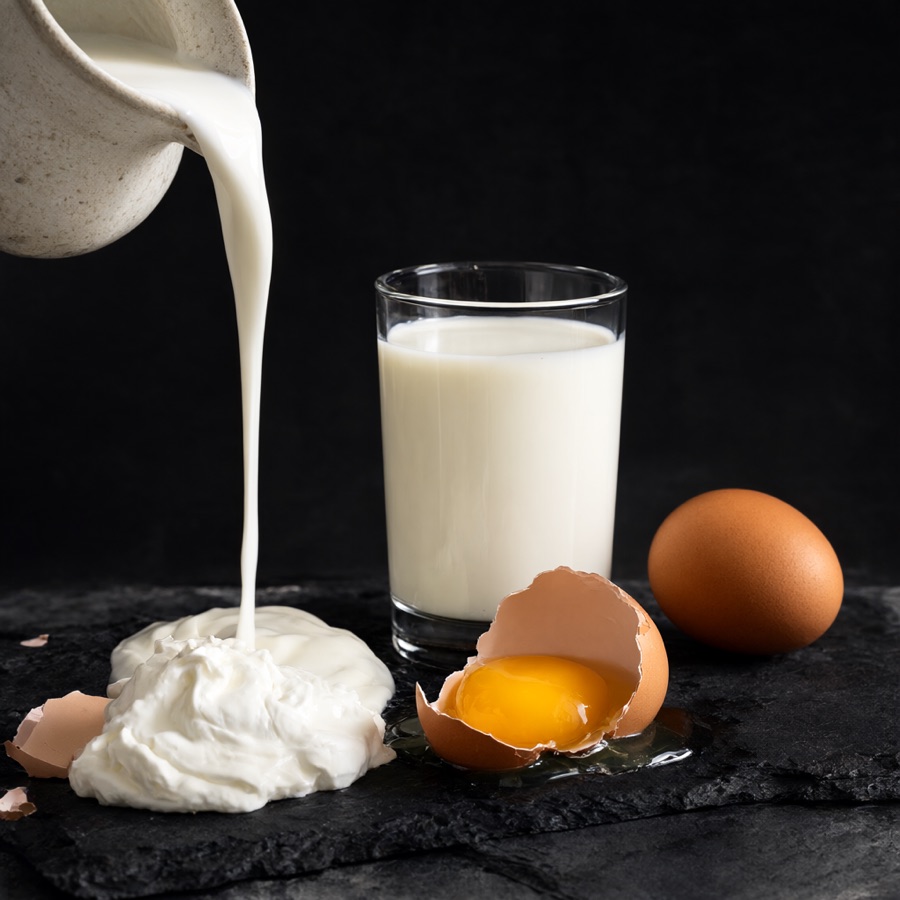
A Complete Guide to Dairy & Egg Ingredients: Emulsification and Texture Science of Cream, Milk and Eggs
A Complete Guide to Dairy & Egg Ingredients: The Emulsification and Texture Science of Cream, Milk and Eggs
Beyond sweet, sour, bitter and proof, cocktails carry a dimension that is often overlooked yet decisive: texture. The roundness of cream, the clarity of milk, the airy foam of egg white and the rich emulsion of yolk together form the skeleton of Fizzes, Flips, the Ramos and milk-washed punches. A Ramos holds its foam crown aloft, and a Flip clings silkily to the glass, because of what fat and protein are doing underneath. Understanding the composition and behaviour of these ingredients will let you reproduce silky, uncurdled, stable results far more reliably than memorising recipes ever will.
1. Fat and protein: why dairy and eggs define body
Milk is roughly 87% water, 3-4% milk fat and about 3% milk protein, split into casein and whey. It is the fat that shapes mouthfeel: fat globules wrapped in phospholipid membranes melt slowly on the palate, delivering the heavy, lingering, coating sensation we call body. The proteins, meanwhile, do the emulsifying. Casein floats as micelles with one water-loving and one fat-loving end, binding the aqueous and fat phases so oil and water no longer part. Shaking cream into a sour is, in essence, using mechanical force to break the fat globules and then letting protein hold them suspended in an acidic liquid. This is why high-fat dairy can edge a sharp lemon acidity, rounding it from harsh to smooth.
2. Grading cream and milk: fat percentage decides the job
The single deciding metric is fat content. Heavy cream at about 36% fat whips into a stable network and is the first choice for a Ramos, Irish coffee and cream liqueurs; light cream at about 20% adds roundness without weight; half-and-half at 10-12% suits drinks that want a milky note without richness; whole milk at about 3.5% appears mainly in Flips and milk-washed punches. The higher the fat, the easier the whip, the stiffer the foam and the more acid-tolerant the liquid. Shelf-stable UHT cream has partly denatured protein: it whips poorly and tastes flat, so the bar should prefer pasteurised refrigerated cream, used soon after opening. Higher fat also resists flocculation in lemon juice, the chemical reason acid-forward creamy drinks call for heavy cream rather than milk.
3. White and yolk: two ingredients with opposite jobs
Egg white is about 90% water and 10% protein; its ovalbumin unfolds under the shear of shaking and traps air, building the fine, lasting foam, the mousse crown atop a Sour or Fizz. The yolk is rich in lecithin, a natural emulsifier that binds fat and water tightly, giving a thick, silky, faintly sweet body at the heart of Flips and eggnog. The two can be divided or combined: white alone for a light foam, whole egg or yolk for a dense texture. In quantity, one white is about 30 ml, enough for a standard sour; half a yolk already thickens noticeably, and more turns savoury. Always use pasteurised or edible-raw-grade eggs, since salmonella is not a gamble to take, and discard any egg with a cracked shell or long room-temperature storage.
4. Operating parameters: dry shake, reverse dry shake and the cream whip limit
The standard sequence for foamed drinks is dry shake then wet shake: shake hard for 15-20 seconds with no ice so the protein whips undiluted and near room temperature, then add ice and shake 10 seconds to chill and set. Adding ice from the start chills the protein and suppresses unfolding, leaving a sparse, collapsing foam. The reverse dry shake inverts this: shake on ice first to chill, strain off the ice, then dry-shake again to build foam, suiting drinks that chase a finer, denser head. A cream-laden Ramos goes further, the classic method shaking for minutes until the foam is stiff enough to hold the liquid, while modern bars speed this with a whip ball or a milk frother. The critical limit is that over-shaking cream crosses from whipped straight into breaking: the emulsion splits, butter granules appear and the drink turns curdled. Shake in stages and open the tin to check rather than overshooting in one go.
5. Safety, substitutes and common mistakes
For vegan or allergy settings, aquafaba replaces egg white: about 30 ml equals one white and whips a stable foam, with only a faint legume note. Coconut cream or oat cream can stand in for dairy fat, though coconut will mask delicate milk notes and the recipe must shift accordingly. The three most common errors: pouring milk straight into a high-acid drink, where low-fat milk flocculates and clots the moment it meets lemon, so use high-fat cream or milk-wash first; shaking with room-temperature whites, which badly cuts foam volume and stability, so keep eggs and cream cold; and adding sugar too early or too heavily, which suppresses the foam, so add syrup after the dry shake or reduce it. Milk-washing clarification exploits exactly the casein-acid flocculation that elsewhere counts as an accident, adsorbing colour and tannin before filtration. Master these and dairy-and-egg drinks stop being folklore and become repeatable, parameterised technique.
6. Mapping the principles back to the classics
The theory reads clearly once returned to the canon. The Ramos Gin Fizz calls on egg-white foam and heavy-cream body at once, the extreme case of dairy and egg working together; the Flip trades on whole egg for a clinging, viscous pour; Brandy Milk Punch and milk-washed punches turn casein flocculation from a fault into a method; classic eggnog leans on yolk emulsification for its festive weight. Decide first whether you want foam, body or clarity, then choose white, yolk or fat, and the recipes fall into place on their own.
More tips


334 cocktail recipes, one tap away
Browse by base spirit, flavor and strength. Save your favorites.
Open MixMyth