The Cocktail Temperature Guide: Why Serving Temperature Decides Everything
The Cocktail Temperature Guide: Why Serving Temperature Decides Everything
By the time a cocktail reaches the guest, nearly every flavour parameter has been locked in: the ratio, the ice quality, the technique. But one variable keeps changing after the drink leaves the bar, and it reshapes the entire flavour structure — temperature. It simultaneously controls aroma intensity, the balance between sweetness and bitterness, the rate of dilution, and the physical feel of the drink in the mouth. Understanding temperature is the final piece of understanding why a cocktail tastes good.
How Temperature Reshapes Flavour
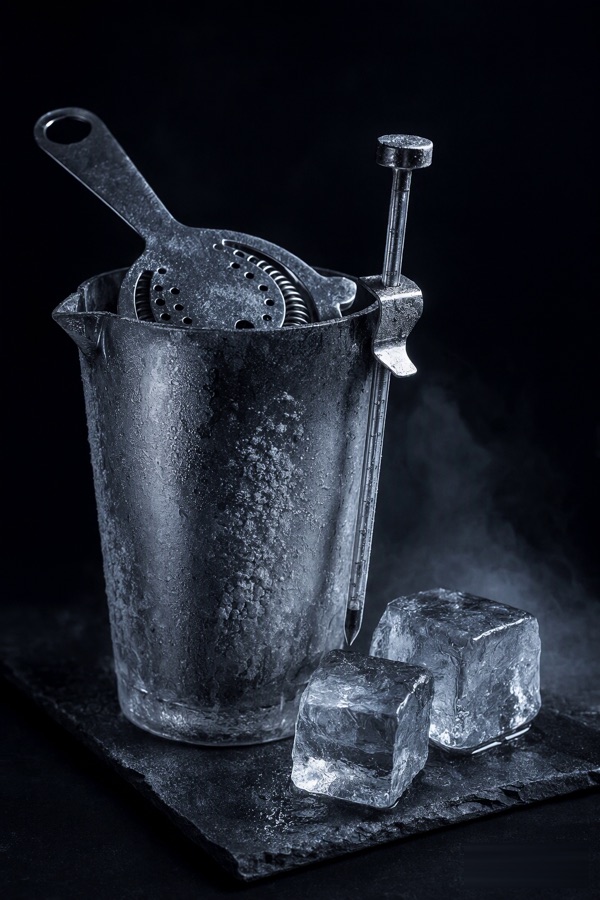
The interference is comprehensive. On the aroma side, aromatic molecules evaporate at an exponentially higher rate as temperature rises: the same drink at 4°C and at 12°C presents two different aroma intensities — which is why cold drinks read as clean and restrained while warmer ones open into florals. On the taste side, cold suppresses the perception of sweetness and sharpens both alcohol burn and bitterness; as the drink warms, sweetness surfaces and bitterness rounds off, and the structural centre of gravity of the whole drink shifts. On texture, colder liquid is denser, and gas solubility is higher: a chilled sparkling drink has fine, persistent bubbles, while a warmed one goes coarse and flat. Dip a probe thermometer into a freshly strained drink once, and you will start building intuition for all of this.
Target Ranges by Family
Shaken short drinks (sours, fizzes, daisies): roughly 0°C to -3°C. Violent shaking drives the liquid below the freezing point within seconds, and with 20-30% dilution the result is icy and full-bodied. Stirred short drinks (martinis, manhattans, negronis): about -2°C to 0°C — gentler stirring keeps dilution between 15% and 25% while preserving the silky texture. Highballs and long drinks: 2-4°C, held there through the whole serve by a full column of ice; a long drink above 6°C is almost always out of balance. Sparkling aperitifs (the spritz family): 4-6°C, leaving a little room for the aromatics to lift. Hot drinks (toddy, Irish coffee): 55-65°C is the golden window — below 50°C the aromatics stay muted and the alcohol rough, above 70°C alcohol and delicate aromatics boil off and sweetness turns syrupy.
Hitting and Holding the Target
Pre-chilling is the foundation: store glassware in a freezer (-18°C, at least 15 minutes). A room-temperature martini glass instantly raises a freshly stirred drink by 4-6°C, undoing everything. Ice discipline: large, hard cubes for short drinks to slow dilution; a full glass of ice for long drinks to hold temperature — a highball filled only halfway is lukewarm within ten minutes. Mixers such as soda and tonic must come from the fridge: room-temperature soda poured over ice melts a large share of it and wrecks the ratio. Working time counts too: after 12-15 seconds of shaking or 30-40 stirs, strain immediately — every extra ten seconds in the tin advances the dilution. After service, a standard short drink holds its ideal window for only 8-10 minutes, a long drink for about 15.
Common Mistakes
Mistake one: chilling the drink but not the glass. Temperature starts leaking the moment liquid touches warm glass; pre-chilling is not optional. Mistake two: crushed ice in short drinks — the enormous surface area finishes dilution before the drink reaches temperature, so the drink goes watery before it goes cold. Crushed ice belongs to swizzles and frozen drinks only. Mistake three: boiling hot drinks — alcohol and fine aromatics escape well below 78°C; hot drinks need to be brought to about 60°C and held, not scorched. Mistake four: judging temperature by feel — your hand is far warmer than the drink, and the stem that feels "cold enough" is usually two degrees late. Calibrate with a probe thermometer now and then, and reset your touch. Temperature is the one parameter that never appears in a recipe yet works on every single serve — build it into your workflow, and every drink you make goes up a level.
More tips
356 cocktail recipes, one tap away
Browse by base spirit, flavor and strength. Save your favorites.
Open MixMyth