Cocktail Strength Design: A Complete Guide to ABV Calculation, Dilution Math and Body Balance
Cocktail Strength Design: A Complete Guide
Why ABV Is the Core Variable in Recipe Design
Beyond flavor balance, the most intuitive measure of a cocktail is its strength — whether the drink has enough body to feel substantial without burning. Alcohol concentration directly governs perceived viscosity, the rate at which aromatics volatilize, and how long flavors linger on the palate. The same set of ingredients, diluted 10 ml more or less, produces two entirely different drinks. When a professional bartender designs a recipe, a mathematical question is always running in the background: what will the actual ABV be when this glass reaches the guest? That single number determines the first-sip impression — "silky and powerful," "watery and flat," or "throat-scorching."
Alcohol is not merely a number; it is the carrier and solvent of flavor. Many aromatic compounds dissolve and volatilize optimally only within a specific alcohol concentration window: too high and molecules remain trapped in the liquid phase where the nose cannot reach them; too low and fat-soluble flavor compounds precipitate, leaving the drink cloudy and thin on the palate. The essence of strength design, therefore, is finding that window between "comfortable mouthfeel" and "aromatic release" — for most cocktails the sweet spot falls between 15% and 28%.
The Basic Formula: Volume-Weighted Average
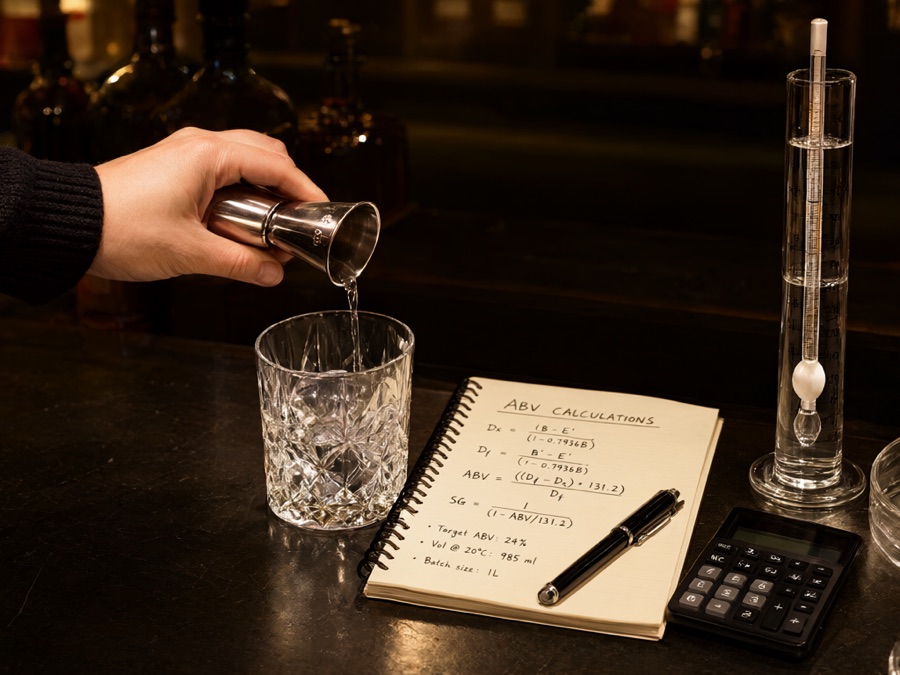
The strength of a mixed drink can be estimated with a volume-weighted average: finished ABV equals the sum of (each component’s volume multiplied by its ABV), divided by total finished volume. Take a classic Daiquiri: 60 ml white rum (40%) plus 30 ml lime juice (0%) plus 15 ml simple syrup (0%), with roughly 25 ml of dilution water added during shaking. Total finished volume is approximately 130 ml; pure alcohol equals 60 times 0.4, or 24 ml; finished ABV is approximately 24 divided by 130, or 18.5%.
Three critical points: First, only alcoholic components contribute to the numerator; every component including dilution water contributes to the denominator. Second, liqueurs are far from "non-alcoholic garnishes" — Cointreau at 40%, Campari at 25%, vermouth at 16% — they contribute alcohol to the numerator while adding volume to the denominator. Omitting liqueur ABV is the single most common calculation error. Third, the formula assumes volumes are additive (in reality, alcohol-water mixing causes approximately 2–4% volume contraction); for precision within plus or minus 1% this is perfectly reliable, while higher accuracy requires contraction coefficient tables.
Dilution Math: Water Addition Rates for Shaking and Stirring
Ice melt during preparation is not random — it is governed by time, total ice surface area, and the initial temperature differential. Empirical benchmarks from controlled testing:
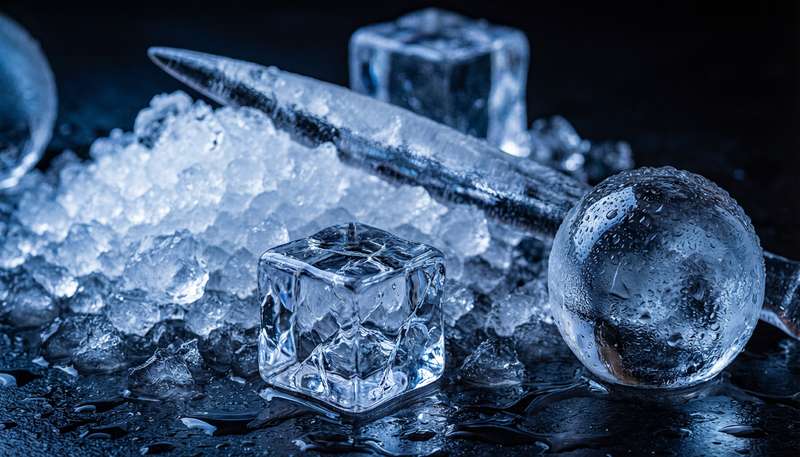
Shaking for 10 to 15 seconds adds approximately 20–25% water relative to pre-shake liquid volume. Crushed ice, with its enormous surface area, can reach 30%; a single large sphere adds as little as 15%. A three-stage shake (short initial shake to combine, long main shake to chill, final hard shake to aerate) yields about 3 percentage points less dilution than a single continuous aggressive shake, because early-stage melt rate is lower while the ice surface has not yet fully equilibrated.
Stirring for 20 to 30 revolutions over approximately 20 to 30 seconds adds about 20–30% water. Large cubes provide a steadier, more controllable rate; by counting revolutions you can reproduce the exact strength of a given drink. The goal of stirred cocktails (Martinis, Manhattans, Negronis) is "minimum dilution to maximum chill" — large ice, extended stirring, and a cold environment are the three control points.
Building in the glass depends on ice volume and drinking pace: the first sip sees roughly 5–10% dilution, increasing by about 2–3% per minute thereafter. Highball-style drinks must account for "last-sip concentration" — if a Gin and Tonic takes 15 minutes to finish, the final sip will be 30–40% weaker than the first, so the initial recipe strength should be calibrated upward accordingly.
Dilution does more than lower ABV — it opens up flavor. At high alcohol concentration, aromatic molecules remain trapped in the liquid phase unable to reach the nose; moderate water addition restructures the hydrogen-bond network, accelerates volatilization and reveals layered aromatics. This is precisely the science behind "adding a few drops of water to make whisky bloom."
Target ABV Ranges by Cocktail Style
Different cocktail families have classic strength zones; straying too far creates cognitive dissonance for the drinker:
Up drinks (coupe or martini glass, no ice) target 22–32%. Martinis and Manhattans live here — a definite alcohol presence without burn, with enough body and weight to carry the aromatics in the glass.
Sours (served up or on the rocks) target 15–22%. Citrus acidity and sugar buffer the perception of alcohol by roughly 3–5 percentage points below the actual number, so even an 18% Daiquiri never tastes "weak."
Highballs and long drinks (generous ice plus carbonated mixer) target 8–15%. Dilution and CO2 doubly suppress perceived strength for easy, refreshing sipping. The real design challenge is not the upper limit but the lower one — below 6% the drink crosses from "cocktail" into "alcoholic beverage."
Hot drinks (Toddies, Irish Coffee, Hot Buttered Rum) target 10–18%. Elevated temperature dramatically amplifies alcohol burn — the same 15% liquid that feels gentle when cold becomes noticeably harsh at 60°C. Hot drinks therefore require 3–5% lower ABV than their cold counterparts for equivalent comfort.
Shots and short drinks target above 28%. Tiny volume (30–60 ml) consumed in one go, designed for concentrated impact — an entirely different design logic from any of the above categories.
Common Mistakes and Practical Calibration
Mistake one: ignoring pre-chill dilution. The residual water film left after rinsing a shaker or mixing glass with ice water contributes an extra 3–5 ml that must be factored into competition or tasting-level precision.
Mistake two: treating recipe-listed volume as finished volume. A recipe totaling 105 ml of ingredients does not mean 105 ml in the glass — after shaking, with dilution water, the finished drink is approximately 130 ml. ABV must be calculated against the finished number.
Mistake three: neglecting ambient temperature. The same shaking duration at 30°C in summer versus 18°C in winter can differ by 3–5 percentage points in dilution rate. Professional bars adjust timing seasonally or use temperature-controlled ice to maintain consistency.
Practical calibration workflow: Step one, estimate theoretical ABV using the formula. Step two, after actual preparation, measure finished volume with a jigger and back-calculate real water addition. Step three, compare theoretical versus actual — if too strong, extend stirring by 5 seconds or add one extra short shake; if too weak, shorten the operation or switch to larger ice to slow melt rate. Step four, log your equipment-specific water addition rate — the same shaker, ice type and technique is highly repeatable within plus or minus 2 ml, so once you establish your personal calibration constant you can apply it directly to new recipe development.
ABV calculation is not about turning bartending into a chemistry class — it provides a quantitative anchor for recipe adjustment. When a guest says "too strong" or "I can barely taste the spirit," you know exactly which variable to move and by how much. That is what recipe design skill truly means.
More tips
356 cocktail recipes, one tap away
Browse by base spirit, flavor and strength. Save your favorites.
Open MixMyth