The Complete Guide to Cocktail Spices: Cinnamon, Clove, Nutmeg and Allspice
The Complete Guide to Cocktail Spices: Cinnamon, Clove, Nutmeg and Allspice
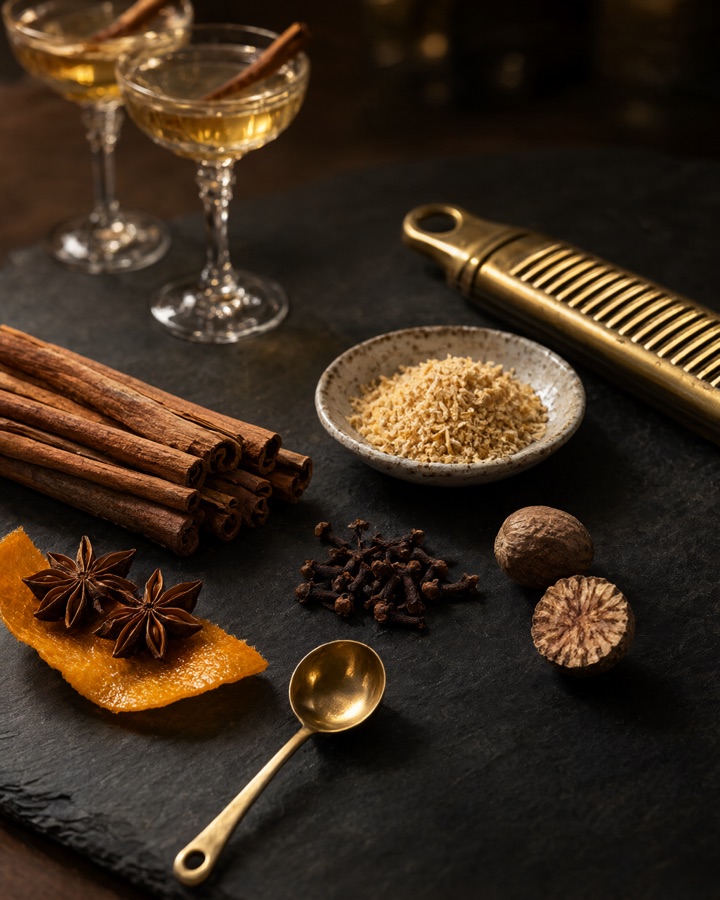
Spices are the most underrated ingredient family in cocktails. They do not supply bright acidity like citrus or direct sweetness like syrup; they work at trace doses in the finish and in the nose, deciding what a drink smells like. Spice is also one of the few families that serves nose and palate in sequence: freshly grated nutmeg floated on foam is received by the nose first, while cinnamon syrup dissolved in the body is confirmed by the tongue, giving a drink a two-act narrative. Understanding their flavour chemistry and extraction logic is what turns winter classics such as the Hot Toddy, Eggnog and mulled wine from recipe-copying into consistent, professional output.
Where Spice Flavour Comes From: Volatile Oils and Dose Thresholds
The flavour of a spice is mostly volatile essential oil: cinnamaldehyde in cinnamon, eugenol in clove, myristicin and pinene in nutmeg, eugenol and cineole in allspice. Perception thresholds for these compounds sit in the parts-per-million range, which means the distance between "a hint" and "too much" is often a single tremor of the hand. Three working dose baselines: one whole cinnamon quill per 200 ml of syrup; no more than two whole cloves per hot drink; one or two fresh gratings of nutmeg per glass, floated on top. Past the threshold the spice stops being background and becomes the protagonist, burying the base spirit and the citrus and leaving the drink bitter, flat and one-dimensional.
Four Extraction Routes: Hot Infusion, Cold Infusion, Fresh Grating and Toasting
First, hot-infused syrup: simmer the spice with 1:1 syrup to 60-70 C, take it off the heat, cover and steep for 15-20 minutes, then strain. Boiling or over-steeping oxidises cinnamaldehyde into woody bitterness. Second, cold infusion in spirit: steep whole spice in spirit above 40% ABV at room temperature for 24-72 hours to build a tincture you dose by the dash - the most controllable route. Third, fresh grating: nutmeg and allspice must be grated to order; within ten minutes of grating, half the volatile oil is gone and pre-ground powder is little more than coloured sawdust. Fourth, toasting: warm cinnamon quills in a dry pan for twenty seconds, or lightly torch orange peel before pairing it with spice, to wake dormant oils - but scorching ruins the whole batch.
Batch Baselines for Spice Syrups and Tinctures
Home bars and professional bars can prep to the same baselines. Cinnamon syrup: 200 ml of 1:1 syrup with one whole quill, steeped off-heat at 60-70 C for 20 minutes, strained and refrigerated for up to two weeks - the sweet, warm backbone for Hot Toddies, Coquito and any long drink needing a toasty floor. Clove syrup drops the dose to two buds per 200 ml and the steep to 10 minutes, or the medicinal note swallows the sweetness. Nutmeg is never syruped; it lives as fresh grating and as tincture - one whole nutmeg in 100 ml of vodka for 48 hours, strained, then dosed at 1-2 dashes per glass to give eggnog and cream drinks a nutty finish. Allspice tincture follows the same method but must be tasted at 24 hours, since its eugenol releases far faster than nutmeg's. Label and date every batch; discard tinctures older than three weeks.
Pairing Logic with Base Spirits: Homologous Complement
Spice and spirit pair by homologous complement. Cinnamon's sweet warmth shares a lineage with the caramel and oak of rum and bourbon, making it the backbone of eggnog, Hot Toddy and coconut-cream drinks. Clove's medicinal punch cuts through gin's juniper and vermouth's botanicals, but its dose must be halved. Nutmeg's creamy, fatty aroma flatters cream, coconut and whole-egg bodies, and works better floated on foam than dissolved in the liquid. Allspice carries clove, cinnamon and nutmeg in a single berry; it is the heart of allspice dram in tiki formulas, and substituting it for a single spice rounds out the whole structure.
Common Mistakes and Corrections
Using pre-ground powder instead of fresh: shelf cinnamon loses nearly all its volatile oil within months and contributes colour, not aroma. Over-steeping without straining: cold tinctures left beyond 72 hours leach tannin and bitterness, so taste on a schedule and strain on time. Treating spice as garnish only: nutmeg floated on the surface owns the first aromatic impression while spice syrup owns the mid-palate structure; the two roles are not interchangeable. Ignoring varietal difference: Ceylon cinnamon is sweet and gentle, Chinese cassia is hot and pungent - buying the wrong one shifts an entire batch of syrup, so always check the origin label. Confusing quills with powder: whole quills belong in steeped syrups and rim garnish, while cassia powder belongs in dry spice blends and baked-style drinks; swapping the two gives steeped batches a sharp, phenolic bite.
More tips


320 cocktail recipes, one tap away
Browse by base spirit, flavor and strength. Save your favorites.
Open MixMyth