Smoking Cocktails: The Complete Guide to Woods, Methods and Flavor Control
Smoking Cocktails: The Complete Guide
Smoke was once dismissed as a molecular-mixology party trick; today it is one of the most restrained and most powerful seasoning tools on the bar. It belongs to none of the four tastes - sweet, sour, bitter, salty - and instead works directly on the olfactory sense, laying a texture of fire and time over the body of a drink. Understanding how smoke is generated, and where its limits lie, is what lets it land precisely in the glass instead of overwhelming everything else.
Why Smoke Flavors a Drink
When wood burns, cellulose, hemicellulose and lignin break down at different temperatures and release a family of volatile phenols and aromatic compounds. Guaiacol gives a gentle sweet smoke with a clove-like lift; syringol contributes a heavier, woodier smoke; furfural supplies a base note of caramel and almond. Most of these molecules are aromas rather than tastes, so smoke is perceived mainly through retronasal olfaction - which is why a smoked drink makes its strongest impression in the moment before the first sip, at the nose. The key is cold smoke: fully combusted, high-temperature smoke carries heavy tars and harsh phenols that taste acrid and bitter, while the smoldering, oxygen-starved burn of low temperature yields a cleaner, sweeter aromatic smoke. What bartending wants is that incomplete-combustion cold smoke, never the black smoke of open flame.
The Flavor Logic of Wood Selection
A wood's density and sugar content decide the character of its smoke. Fruitwoods such as apple and cherry are light and faintly fruity, suited to gin, rum and citrus-driven recipes where they will not crush a delicate body; hickory and oak burn bold and heavy, a natural match for bourbon and rye, and able to support richer, oilier builds; mesquite is aggressive and earthy, often used to echo mezcal. Peat smoke is a separate route entirely - its phenols come from peat rather than wood, as in Islay Scotch. The governing principle is affinity and matched intensity: delicate spirits take light smoke, weighty spirits take heavy smoke. Never bury a recipe whose whole point is freshness under a dense cloud. Chip size also changes burn rate: fine chips catch fast and give a bold burst of smoke, ideal for short cloche work; coarse chunks smolder slowly with a gentler smoke, better where contact runs a little longer. Beginners should start with fine fruitwood chips, the most forgiving of all.
Cold Smoke Versus Hot Smoke
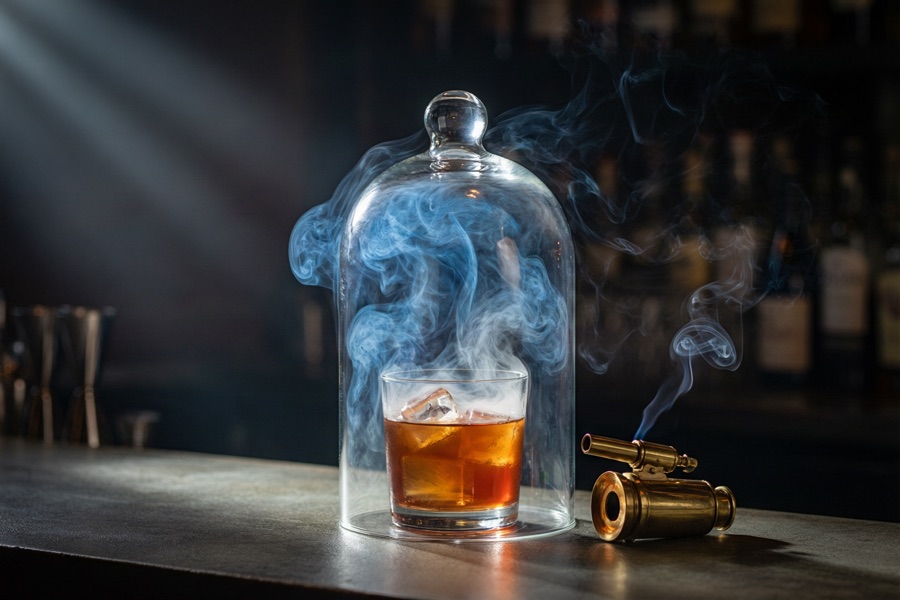
Homes and bars use almost exclusively cold smoke. The smoking gun is the most common tool: wood chips burn in a chamber and a tube delivers the cold smoke into a sealed space. Paired with a glass cloche, the gun lets you seal smoke over a finished drink tableside, equal parts theater and technique. Hot smoking - holding a drink above burning chips for an extended time - runs hot and risky, driving off alcohol and turning flavor bitter; professional bars rarely use it. Either way, contact time is the core variable: once cold smoke is injected, thirty seconds to two minutes of sealing is plenty. The longer it sits, the more harsh phenols deposit and the bitter it becomes.
Four Mainstream Techniques
First, smoking the glass: fill an empty glass with cold smoke from the gun, cap it with a coaster to trap the smoke, pour out the excess, then build the drink; the aroma clings to the walls and releases slowly as you drink. Second, cloche smoking: once the drink is finished, seal it under a smoking dome for a few dozen seconds; lifting the dome releases a wave of aroma - the most common tableside presentation in restaurants. Third, smoking the garnish: kiss a sprig of rosemary, a cinnamon stick, an orange peel or a whole nut with a torch until the surface chars and smokes, then set it on the rim - low smoke volume, high control. Fourth, smoking the ingredients: fold smoke into the base or the modifiers, as in smoked ice, smoked syrup, smoked salt, or even spirit rested in a smoked barrel. Beyond these, simply choosing a spirit that already carries smoke - mezcal, peated whisky, smoked malt - is the easiest and most reliable route of all.
Common Mistakes and Dosing Control
The most common failure is excess: smoke is a brutally dominant element, and too much leaves a glass with nothing but acrid phenolic bitterness that masks every other detail. Second is wet wood: damp chips smolder into a sour, musty smoke, so store them dry and sealed. Third is open-flame black smoke: visible dense black smoke is almost pure tar - let the chips smolder and give off pale smoke instead. Fourth is ignoring ventilation: sealing smoke indoors will trip a smoke alarm, so mind your environment before you start. On dosing, treat smoke like bitters rather than syrup - increase it in units of seconds, and err on the side of less. A drink needs only a faint shadow of smoke, and the moment the cloche lifts your guest will smile.
Smoking is not bringing fire into the glass; it is folding a span of burning time into flavor. From wood choice to temperature to the stopwatch, every variable serves one goal: let smoke support, never star. If you worry the smoke runs warm, thread an ice-water bath or a metal condenser coil into the middle of the tube to cool it further and strip out part of the tar - a standard trick when a silky mouthfeel is the aim. Master restraint, and smoke stops being a gimmick and becomes the most elegant seasoning in your hand.
More tips
274 cocktail recipes, one tap away
Browse by base spirit, flavor and strength. Save your favorites.
Open MixMyth