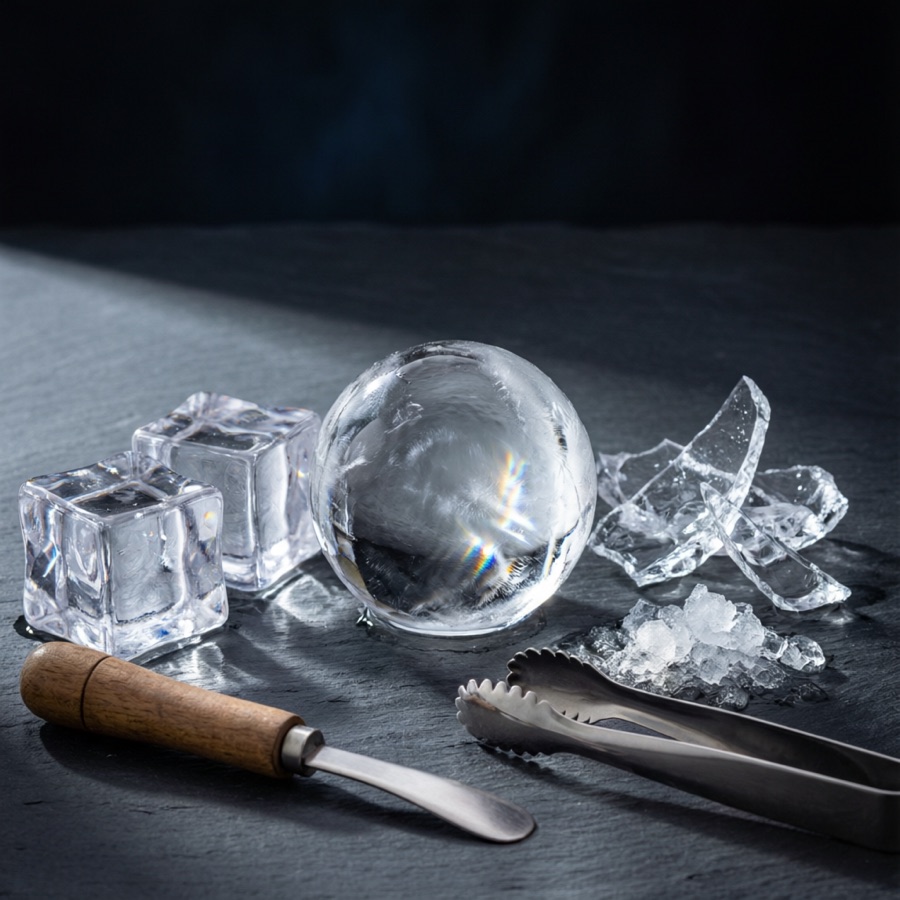
Cocktail Ice Complete Guide: Density, Clarity and Melt Rate
Cocktail Ice Complete Guide: Density, Clarity and Melt Rate
Ice Is the Invisible Ingredient
Bartenders often say a cocktail has four ingredients: spirit, sugar, acid, and water. And nearly all of that water comes from ice. From the moment ice enters your tin, it begins to melt, dilute, and chill - three actions happening at once that determine the final proof, temperature and mouthfeel. Understanding ice is understanding the skeleton of a cocktail. Many home drinks fail not because of the recipe but because of bad ice: too small, too old, or carrying freezer odors, all of which turn a balanced drink thin or murky.
Density and Melt Rate: Surface Area Rules Everything
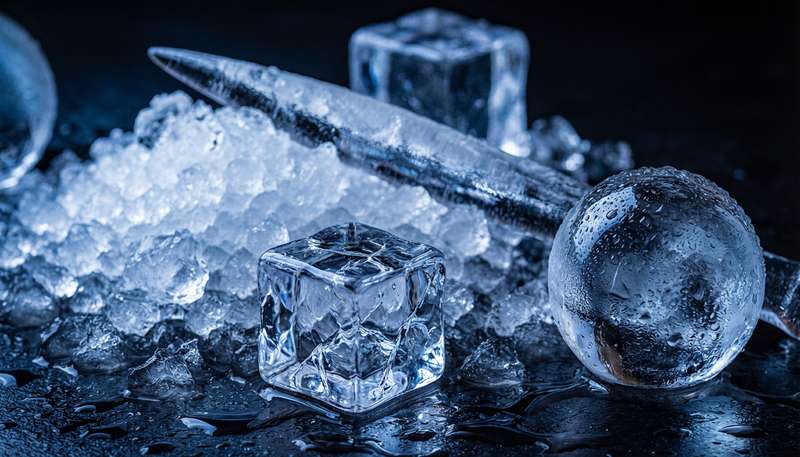
The melt rate of ice depends on the surface area in contact with liquid. For the same volume, crushed ice exposes dozens of times more surface than a large sphere, so it melts fast and dilutes hard; a big sphere has the least surface, melting slowest and diluting least. This is why tiki drinks on crushed ice taste bright and light, while an old fashioned over a single sphere stays rich for twenty minutes. When shaking we use medium cubes to chill fast and add controlled dilution in seconds; when stirring we use large old ice to chill slowly and limit dilution. Choosing ice is, in essence, choosing a dilution curve. One overlooked variable is the age of the ice: hard ice straight from the freezer has a dry, cold surface and melts slowly; ice left out for a few minutes grows surface frost and weeps, diluting out of control the moment it hits the glass.
Clear Ice vs. Cloudy Ice: Causes and Effects
Home-freezer ice turns white because freezing water pushes dissolved air and minerals toward the center, forming a cloud of micro-bubbles. These bubbles hurt the look and make the ice structurally loose, so it melts faster. Clear ice is made by directional freezing - letting water freeze slowly from one direction so impurities are pushed into the last unfrozen zone, which is then cut away. Clear ice is denser and melts slower, the first choice for old fashioned and rocks drinks. Note that cloudy and clear ice taste the same; the difference is melt rate and visual texture. In shaken drinks the ice is strained out, so clarity barely affects the result - do not obsess over it there.
Choosing Ice Forms: From Big Spheres to Crushed
A large sphere (about 6 cm) suits the rocks glass and melts slowest; a big cube (5 cm) suits rocks and stirred drinks; medium cubes (3 cm) suit shaking; cracked and crushed ice suit tiki, mint julep and any drink needing fast chill and high dilution; crushed ice also anchors frozen drinks like the sgroppino. One rule covers it all: the richer and slower the drink, the bigger the ice; the brighter and quicker the drink, the smaller the ice. Match the glass too: a wide rocks glass takes a big sphere, while a narrow highball suits a square column.
Home Ice: Directional Freezing and Molds
The simplest home route to clear ice is directional freezing: fill a small insulated cooler with filtered water, leave the top open, and freeze for 24 to 36 hours so ice forms top-down; impurities collect in the unfrozen bottom, which you cut away. Without a cooler, boiled-then-cooled water frozen slowly still improves clarity noticeably. For molds, silicone sphere and cube trays are plenty; rinse surface frost off under water before the ice meets the glass. When making batches, store finished ice in sealed bags back in the freezer to avoid odors and surface sublimation.
Common Mistakes
First, the belief that more ice means more dilution - the opposite is true: a full glass of big ice melts slower than a half glass of small ice, because less surface touches each sip of liquid. Second, re-freezing old ice - surface frost and cracks speed melting and carry freezer odors. Third, ignoring ice temperature: ice straight from the freezer at minus eighteen degrees chills faster than ice near zero, so shake with freshly pulled hard ice. Fourth, treating ice as an infinite backdrop - ice expires; discard and remake anything stored beyond two weeks. Treat ice as an ingredient you manage, and every pour becomes more consistent.
More tips
282 cocktail recipes, one tap away
Browse by base spirit, flavor and strength. Save your favorites.
Open MixMyth