The Complete Guide to Citrus: Lemon, Lime and Orange in Cocktails
The Complete Guide to Citrus: Lemon, Lime and Orange in Cocktails
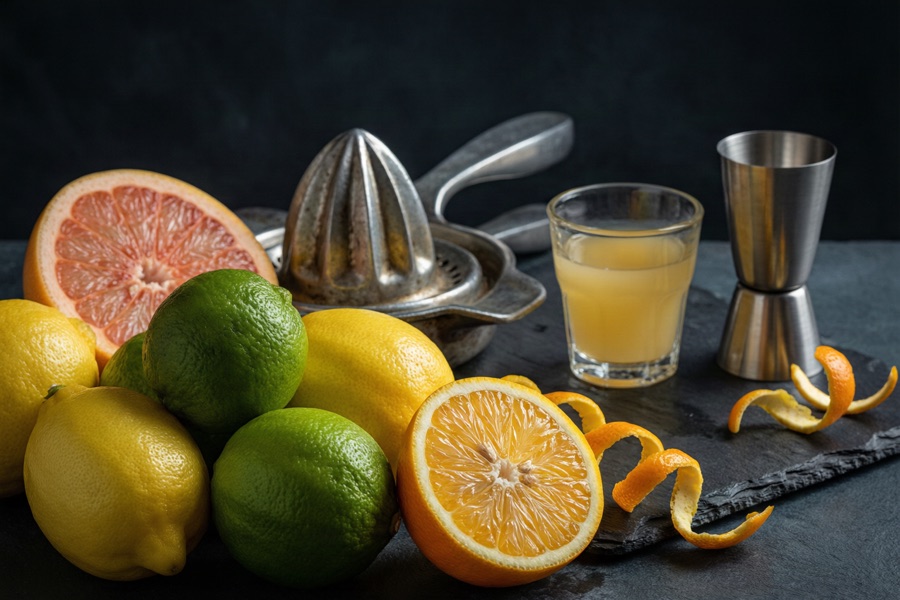
Open any classic cocktail recipe book and more than half the formulas contain citrus juice. Citrus is the most important "invisible base" after spirit, sugar and bitters: it supplies acidity, aroma and freshness, yet it is often dismissed with a shrug and a squeeze. To understand citrus, understand its two axes of flavor: the type of acid, and the oils in the peel.
1. Lemon and Lime: Two Kinds of Sour
Lemon's dominant acid is citric, at roughly 5-6%; lime carries a similar level of citric acid but a higher share of malic acid, with a different volatile aroma profile. On the palate: lemon is bright and rounded, with a honeyed sweetness and clear peel-oil perfume; lime is sharper, greener, with a hint of bitterness and a cooling herbal edge. That difference drives the classic division of labor — gin and whisky sours and fizzes lean on lemon, while rum and agave classics take lime: the Daiquiri, the Margarita, the Mojito. Swapping them will not collapse a drink, but it shifts the whole style: a lemon Daiquiri loses its tropical edge, and a lime Whiskey Sour gets buried under the grain. The acid gap also sets the sugar ratio: a lemon sour usually lands at 2:1:1 (spirit:acid:sugar), while lime, being sharper, often needs 2-3 ml more syrup inside the same frame to balance. The Meyer lemon, lower in acid and scented with blossom and ginger, works as a flavor accent but cannot replace a true lemon as the backbone of a classic. The working rule in one line: brown spirits with lemon, clear spirits and agave or rum with lime; when in doubt, follow the original recipe.
2. Orange and Grapefruit: The Sweet-and-Bitter Midfield
Orange juice is low in acid and high in sugar; its role is not "sour" but "fruit and body" — it softens the alcohol and lends round fruit, exactly the logic of the orange juice in a Blood and Sand. The peel is a second treasury: its oils carry the orange perfume, and expressing a twist over an Old Fashioned or a Martini is a small gesture with outsized effect. Grapefruit sits between sour and bitter: its juice carries a marked bitterness from naringin, and the Paloma and the grapefruit Margarita family are built on that bittersweetness. The working rule for grapefruit: pair it with agave or soda, and give it enough sugar to hold the bitter up — but no more, or it turns cloying. Modern bars also reach for yuzu, sudachi and kumquat: yuzu's aroma is complex, leaning pine and blossom, with less acid than lemon, so it mostly plays an aromatic accent rather than the main acid; sudachi is even brighter and pairs superbly with clear spirits; kumquat goes in peel and all, sweet and bitter in one, muddled into smashes. The logic for the new citrus is the same: first map its acid-sugar ratio and aromatic character, then decide whether it leads as the acid or accents.
3. The Freshness Curve: The Four-Hour Window
Citrus juice is not best the second it is squeezed. Fresh-pressed juice is loud and sharp; after resting, light oxidation rounds the acid and integrates the aroma. The bar-world consensus: lemon and lime juice hit their peak window one to four hours after pressing, and after 24 hours freshness collapses into stale notes. For the home bar, simplify to three rules: squeeze to order and never use bottled juice; if you must prep ahead, seal, refrigerate, and finish the same day; juice left at room temperature for more than two hours goes only into big-batch punch, never into a single sour. Storage of the whole fruit also shapes the yield: chilled lemons and limes juice poorly, so bring them back to room temperature and roll them firmly on the counter to break the pulp — yield rises by a fifth to a third; press with moderate force, since squeezing too hard crushes pith and seeds and presses their bitterness into the juice.
4. Waste Not the Peel: Oleo Saccharum and Peel Infusions
The oil glands in citrus peel are the warehouse of aroma, and the classic extraction is oleo saccharum: peel the zest (avoiding the white pith), bury it in sugar and let it rest for a few hours — the sugar draws the oils out into a fiercely aromatic citrus syrup, the traditional base of punch. The parameters are simple: the zest of 3-4 citrus fruits under about 100 g of sugar, rested at room temperature for 4-8 hours with one stir midway, then strained and fortified with a splash of high-proof spirit; it keeps two weeks refrigerated. Use it in punch in place of part of the syrup, or lengthen it with soda for a zero-proof citrus drink. The same logic makes infusions: lemon peel steeped in vodka or gin for 24 hours gives a clean peel perfume, more elegant than juice. The common mistake is using the leftover shell after juicing — residual juice brings bitterness and water; the correct order is to zest first, then cut and squeeze.
5. Common Mistakes and Practical Advice
Mistake one: all sour is the same — lemon, lime and grapefruit are three distinct flavor ingredients; swapping them rewrites the recipe. Mistake two: fresher is always better — fresh-pressed is the floor, but rested juice is often rounder; advanced palates experiment with the four-hour window. Mistake three: the white pith can go in the juicer — pith is the bitter source; keep it out of zests and garnishes. Mistake four: bottled lemon juice is a fine substitute — its preserved, oxidized flavor ruins any classic. Three drills: build a Whiskey Sour on lemon to set your acid baseline; make a Daiquiri on lime and taste the "green" difference; finish with a batch of oleo saccharum to meet the other face of citrus aroma. Three rounds in, the citrus family finally reads clearly.
More tips
274 cocktail recipes, one tap away
Browse by base spirit, flavor and strength. Save your favorites.
Open MixMyth