Brix and Sweetness Measurement: A Quantitative Scale for Cocktail Sugar
Brix and Sweetness Measurement: A Quantitative Scale for Cocktail Sugar
In bartending, "sweet" is often treated as mysticism. A recipe calls for "15 ml of syrup," yet syrups vary wildly in strength across brands, batches and ratios, so the finished drink drifts. To make a cocktail reproducible and calibratable, sweetness must be converted from a vague sensory guess into a measurable physical quantity. Brix is the core scale of that system.
What Brix actually is
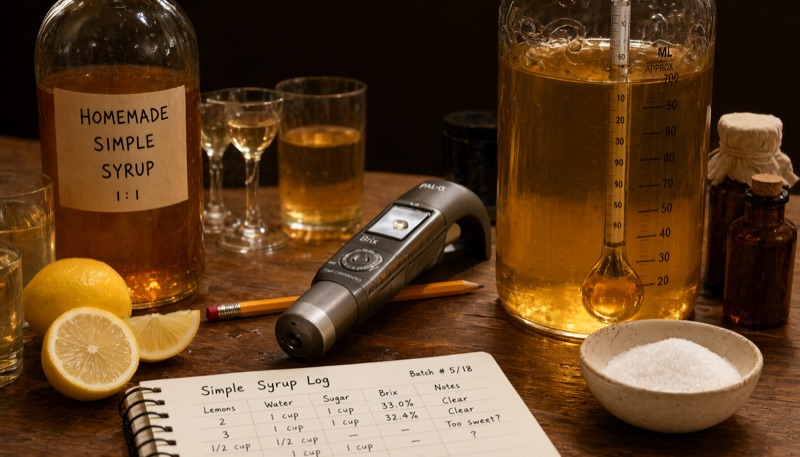
Brix measures the soluble solids in an aqueous solution: 1 °Bx means 1 gram of sucrose per 100 grams of solution. In sugar-dominant liquids such as syrups and fruit juices, Brix reads almost directly as "percent sugar." It originated in the sugar and wine industries to judge grape ripeness and fermentation potential, and craft bartending later adopted it as a common language for standardising syrup strength and comparing ingredients. Once you grasp Brix, you understand why "a spoon of sugar" behaves so differently between a rich syrup and a simple one.
Two measurement tools
A refractometer is the most portable option: place a drop on the prism, read the scale against light, and get a Brix value in seconds. Analog models cost little; digital ones cost more. The principle is simple — the higher the sugar, the greater the refraction. A hydrometer measures density by buoyancy, needs a larger sample, and is common in brewing; with a conversion table it also estimates sugar. For daily bar work a refractometer is enough. Always zero it with distilled water (should read 0 °Bx) and mind temperature compensation — most samples read best near 20 °C.
Standardising syrup strength
A classic simple syrup is 1:1 by weight, roughly 50 °Bx; a rich syrup is 2:1, around 65 °Bx. That is nearly a thirty-percent gap in sweetness, so swapping one for the other without annotation throws a drink off balance. Once you label a recipe "15 ml of 50 °Bx simple syrup," any brand can be matched. Measure each homemade batch once it cools, log the Brix, and batches stop drifting; commercial syrups can be measured and converted too, turning sweetness fully into numbers.
Sugar-acid ratio and perceived sweetness
Sweetness never stands alone. Perception depends on the ratio of sugar to acid, not the absolute amount of sugar. Lemon juice sits around 8 °Bx, but its acidity strongly suppresses sweet sensation, so in the Sour family the real determinant of balance is the sugar-acid ratio. A balanced sour lands within a narrow window of titratable acid to sugar, and bartenders fine-tune it by adjusting syrup rather than the base spirit. Alcohol, temperature, carbonation and bitterness all shift perceived sweetness too: high ABV rounds out sweet sensation, cold dulls it, and bubbles add freshness so a drink reads "less sweet." That is why the same Brix tastes different across recipes.
Common mistakes and a working checklist
Mistake one: building syrup by volume instead of weight — sugar and water differ in density, so cups introduce error; professionals always weigh. Mistake two: ignoring temperature, since hot syrup reads artificially high. Mistake three: equating Brix with the tasting experience — Brix describes total solids, not perception, so it must be read alongside acidity and structure. The practical checklist: keep a refractometer and zero it regularly; log the Brix of every homemade syrup; write Brix in recipes instead of "syrup, to taste"; when adjusting balance move the syrup first, then the acid, then the base spirit; and understand each classic through its sugar-acid ratio rather than absolute sugar. Once sweetness is quantified, you are no longer making "this glass" but a drink anyone can reproduce precisely, anytime.
More tips
356 cocktail recipes, one tap away
Browse by base spirit, flavor and strength. Save your favorites.
Open MixMyth