The Beginner's Toolkit: Minimum Viable Equipment and the Upgrade Path
The Principle: Tools Follow Technique
The classic beginner mistake is buying the complete set up front — most of it gathers dust while two or three pieces do all the work. The rational strategy is to equip yourself for your current technical stage: at entry level you only need to execute three actions — shake, measure, stir — and upgrade later once your hands and your recipe direction have developed. Tools serve motions; if you haven't practiced the motion, the tool is decoration.
The Starter Trio, with Specs
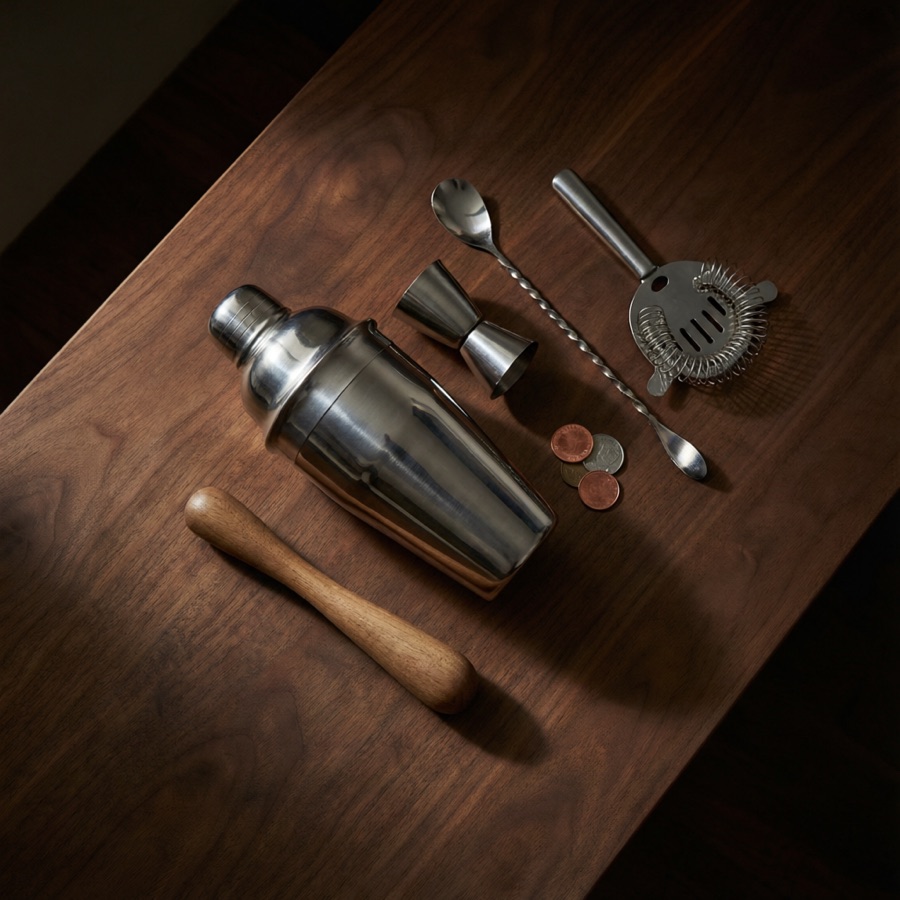
Shaker: a three-piece cobbler of 500 ml or larger. (A Boston shaker needs a separate strainer — not for beginners yet.) The cobbler integrates a strainer and a small measuring cap, covering both shaking and straining in one tool; 500 ml or more guarantees enough collision space once ice is added, and shaking efficiency directly determines foam and integration. Jigger: a double-ended 15/30 ml model is the most practical — classic ingredient quantities almost all land on these two measures or their multiples, and accurate measuring is what makes a recipe reproducible. Bar spoon: 25-30 cm with a twisted handle; the spiral guides liquid for layered pours and makes stirring a Martini (/recipe/1/) or Negroni (/recipe/108/) along the glass wall effortless. The trio costs roughly one hundred yuan-equivalent and covers about eighty percent of classics.
What Your Kitchen Can Legitimately Replace
The test is functional equivalence. Strainer: the cobbler already has one; a household tea strainer works in a pinch, just slower. Muddler: its job is releasing herbs and fruit juice — a thick wooden spoon handle wrapped in cling film handles mint for a Mojito (/recipe/57/) fine. Mixing glass: any thick-walled glass of 400 ml or more; stirred drinks are not fussy about vessels. Ice is the exception — not a tool, yet more important than any tool: freeze 3-4 cm cubes ahead of time and dilution control during shaking and stirring immediately levels up.
Three Categories to Skip
First, electric ice crushers: home ice volume is small, and freezing big blocks in a container then cracking them is faster and cleaner. Second, colorful coated multi-piece sets: coated tools are decorative grade — thin steel, poor balance, bad feel, quick to rust. Third, oversized display pitchers and novelty shapes: they serve presentation, not production, and a beginner has no use for them. Their shared flaw: they occupy counter space and project "I'm serious" while improving nothing in the glass.
The Upgrade Path
After fifty-plus shakes, add two pieces by demand: a Boston shaker (two-piece) for faster ice-out and easier cleaning once you start making drinks back to back, and a Hawthorne strainer whose spring coil catches fine ice chips and muddled debris when paired with the Boston tin and mixing glass. When stirred drinks become your main output, add a spouted mixing glass of 500-700 ml. Precision instruments like spoon scales and thermometers belong to competition and R&D contexts — a home bartender never needs them in a lifetime of mixing.
Source: MixMyth mixmyth.com
More tips
274 cocktail recipes, one tap away
Browse by base spirit, flavor and strength. Save your favorites.
Open MixMyth