A Complete Guide to Batched Cocktails: Pre-Mixing, Dilution Math and Service Speed
A Complete Guide to Batched Cocktails: Pre-Mixing, Dilution Math and Service Speed
Batching is the technique of pre-mixing every stable component of a cocktail in proportion, chilling it in advance, and then simply shaking it over ice or pouring it at service. It was once the core method high-end bars used to keep speed and consistency through a peak, and it has since found its way into home parties. The point of batching is not "throw everything in a jug" but the accurate reproduction of the dilution and chill that ice delivers when you shake or stir a single drink - only by counting that water in up front will a pre-batched drink taste like a freshly made one.
I. Dilution Math: The First-Principles Problem of Batching
When you make a drink fresh, shaking or stirring adds roughly 20%-30% of the total volume in water (about 15-30 ml, depending on technique and duration). When you batch, the drink never meets ice, so you must add that water back by hand; otherwise the pre-batch will be too strong, too sweet and too "hot". The rule of thumb: take the total volume of all non-water components in a single recipe (spirit, liqueur, citrus, syrup) and add about 20% filtered water - up to 25%-30% for shaken drinks, around 15%-20% for stirred ones. A shaken drink with 90 ml of non-water components, for example, takes 18-27 ml of water per serving. Once watered, chill the whole batch; at service you no longer need heavy dilution, only ice to bring it cold.
II. Acid and Citrus: The Most Fragile Link in a Pre-Batch
Fresh citrus juice is the biggest variable in batching. Lemon and lime juice begin to oxidise the moment they are pressed, shifting from bright to bitter and flat within hours. Pre-batches containing fresh citrus should therefore be made in small volume, used the same day and kept cold throughout; to extend shelf life you can partly replace fresh juice with an acid solution (water dosed with citric and malic acid), or press slowly at low temperature and store it away from oxygen to slow oxidation. Syrups and spirits are stable and can be batched for a long time, while citrus, egg white, dairy and anything carbonated should go in just before service. Understanding which components degrade over time is the key to deciding how long a batch will keep.
III. What Can Be Batched and What Must Be Added Fresh
Stable enough to batch: spirits, liqueurs, bitters, syrups, acid solutions and pre-mixed "batch bases". Must be added fresh or just before use: fresh citrus juice (short-term batch only, used the same day), egg white and any protein foam (shaken to order), carbonated elements (soda, tonic, sparkling wine - pre-dissolving them lets the gas escape, so they must be poured at service), dairy and anything that separates (shaken to homogeneity), and the ice itself. Carbonated components especially follow an "add at service" route: top the pre-batched base with soda water, or make a fully pre-carbonated batch (chilled and pressurised - an advanced move). Split your components into two columns by stability and the reliability of the batch is assured.
IV. Scaling a Batch and Managing Containers
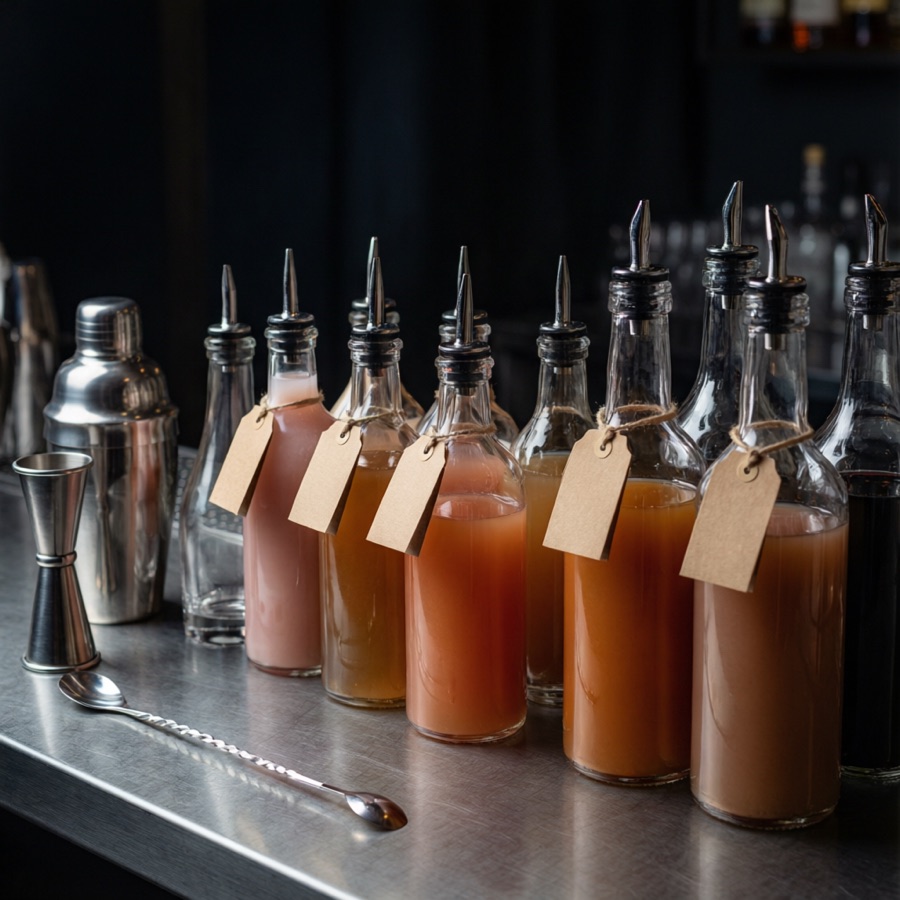
To scale a single recipe into a batch, first fix the sum of all non-water components for "one serving = one drink", multiply by the target number of drinks, then add the calculated water in one go. For 20 servings of a shaken drink with 90 ml of non-water components and 22% added water: 90 x 20 = 1800 ml of base, plus 1800 x 0.22 = about 396 ml of water, for roughly 2.2 L in total. Use graduated, sealable bottles or beverage dispensers, label them with the recipe name, the production date, the total servings and the "ml per serving", and keep them chilled below 4°C. At service, dose each pour with a measuring cup using the "ml per serving" figure so every drink is identical. Label the remaining batch with the date it was opened: citrus-containing batches are used the same day, while pure spirit-and-syrup batches keep for 1-2 weeks.
V. Service Flow and Common Mistakes
The biggest payoff of batching is speed and consistency: at peak, a shaken drink can go from order to glass in a dozen seconds - dose one serving of pre-batch, add ice, shake to chill (no longer relying on it for dilution), double-strain into the glass and garnish. There are four common mistakes. First, forgetting the water, leaving the batch too strong. Second, mixing carbonated or protein components in early, so they are flat or collapsed by service. Third, storing citrus-heavy pre-batches in large volume for a long time, which visibly degrades the flavour. Fourth, missing labels, so the bar grabs the wrong batch and cannot track shelf life. The correct approach is to treat batching as a precise pre-mixing discipline: calculate the dilution first, then separate the components (batch the stable ones, add the volatile ones fresh), and standardise containers and labels, so service is both fast and steady.
VI. Practical Use at Home and at Parties
Home parties benefit just as much: pre-mix and chill a batch of a classic base (the stirred base of a Negroni or Martini, or the shaken base of a Daiquiri), and guests need only stir or shake it over ice to pour drink after drink, freeing the host to leave the bar and join the party. Zero-proof batching is even simpler - chill the juice, syrup, acid solution and soda water separately, then combine a serving and inject the soda water just before drinking, so it stays fresh and never goes flat in advance. Batching moves the burden of "making each drink to order" up front into a single session of calculation and prep, trading a little dilution math for a whole evening of stability and ease - which is exactly why it has travelled from the professional bar to the home table.
More tips
286 cocktail recipes, one tap away
Browse by base spirit, flavor and strength. Save your favorites.
Open MixMyth