The Bar Spoon: A Complete Guide to Structure, the Twisted Handle and the Physics of Stirring
The Bar Spoon: A Complete Guide to Structure, the Twisted Handle and the Physics of Stirring
After the shaker, the strainer and the jigger, the bar spoon is the most underestimated tool in a home bar. It has no complex mechanism and costs very little, yet it decides the texture of every stirred cocktail - the Negroni, the Manhattan, the Old Fashioned. A properly stirred drink should be clear, cold and silky; a badly stirred one turns cloudy, flat or over-diluted. To understand the bar spoon is, in essence, to understand the craft of stirring itself.
Structure: the three parts of a long handle
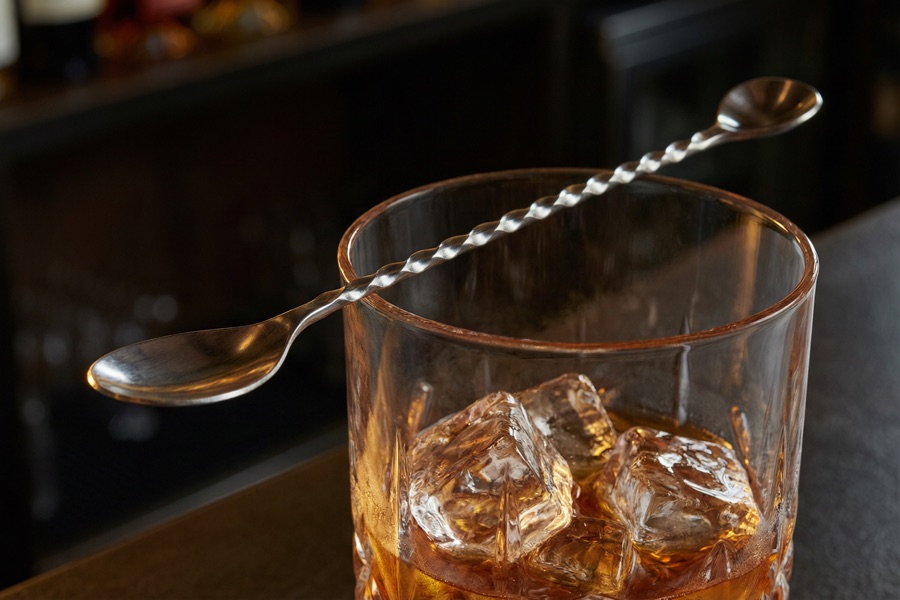
A bar spoon is built from three parts: a weighted or functional head at the end of the handle, the long handle itself, and the bowl at the other end. The bowl holds roughly 5 ml (about one teaspoon) - enough to scoop syrups, bitters and fruit puree, and to act as a guiding surface when you layer. The long handle is what separates a bar spoon from an ordinary teaspoon: it must be long enough to reach the bottom of a mixing glass or tall glass packed with ice, letting you stir and layer without ever touching the liquid. The functional head comes in several shapes - a flat disc that rests on the rim of a glass for layering; a fork for spearing olives and cherries; and a counterweight that adds mass to the end of the handle so the spoon spins more steadily between your fingers.
The twisted handle: far more than decoration
Most bar spoons carry a twisted handle, and many people assume it is purely decorative. In truth it serves two purposes. The first is guidance: when you build a layered drink, letting the liquid slide slowly down the spiral minimises its impact and keeps the boundary between layers of different density crisp. The second is mechanical: as the spoon rotates in the glass, the spiral acts like a tiny screw, organising the liquid into a smoother, more laminar flow and reducing the turbulence and air whipped into it. This is exactly the line between stirring and shaking - shaking drives in air to emulsify and chill with ice crystals, while stirring must cool and dilute evenly without introducing a single bubble.
Material and length: how to choose
Stainless steel is the overwhelming standard for material: corrosion-resistant, easy to clean, and it imparts no off-flavours. Copper and titanium-coated coloured spoons are more a statement of style, though copper conducts heat fast and feels strikingly cold in the hand, which some bartenders love. When buying, first check that the handle is forged in one piece and that the spiral is smooth with no burrs - the seams on cheap spoons trap grime and can even cut your fingers. A length around 30 cm is the most versatile, covering most mixing glasses and highball glasses; if you often build large tiki drinks or tall punches, choose an extended 40 cm-plus model.
Grip and technique: make the spoon spin, not scrape
Correct stirring is not about drawing circles with the spoon, but about keeping the back of the bowl against the wall of the glass and letting the wrist drive the spoon in an orbit around it. The classic grip holds the twisted handle between the thumb, index and middle fingers, leaving the handle free to rotate in the gap between them, much like spinning a pen. The Japanese school pushes this to its extreme: the wrist barely moves, and the fingers roll the spoon so it glides at even speed along the glass wall while the liquid forms a steady vortex. This motion is often called the pull stroke, and its goal is to set the whole mass of ice rotating so the liquid flows evenly across it - not to rattle the cubes against the glass.
Common mistakes
Beginners make three errors again and again. First, stirring too long and diluting the drink into blandness; a Manhattan usually needs only 20 to 30 seconds. Second, using too much force and hammering the ice, which creates chips that cloud the drink and whips in air that ruins the silky mouthfeel. Third, gripping the spoon too tightly and drawing circles with it locked in the palm, which stops it from spinning and is hopelessly inefficient. Remember the three variables of stirring - the balance of time, temperature and dilution - and the bar spoon is simply the tool that lets you hold all three, steadily, in one hand.
More tips
274 cocktail recipes, one tap away
Browse by base spirit, flavor and strength. Save your favorites.
Open MixMyth