The Complete Guide to Agave Spirits: Tequila, Mezcal and Their Flavor Logic
The Complete Guide to Agave Spirits: Tequila, Mezcal and Their Flavor Logic
Over the past decade, agave spirits have moved from the edge of the bar to center stage. Tequila has outgrown the salt-and-lime shot ritual, and mezcal's smoke has become the password of flavor hunters. The two names are often used interchangeably — they are indeed close relatives — but they are distinct categories with different rules. This guide starts from the plant itself and walks through classification, production, label reading, and bottle selection.
Agave: The Single Source of Flavor
Agave is not a cactus; it belongs to the asparagus family. Of its two hundred-plus species, only a few dozen can be used for distilling. Tequila law permits exactly one raw material: Blue Weber agave (Agave tequilana Weber). Mezcal law is far more generous, allowing some thirty species — Espadín dominates plantings, while Tobalá, Tepeztate and Arroqueño are still mostly wild-harvested.
Growth cycles set the economics of the category. Blue Weber matures in 6–8 years, Espadín in 7–9, and wild agaves can take 10–25 years. Raw-material supply, not marketing, is why wild expressions command such prices.
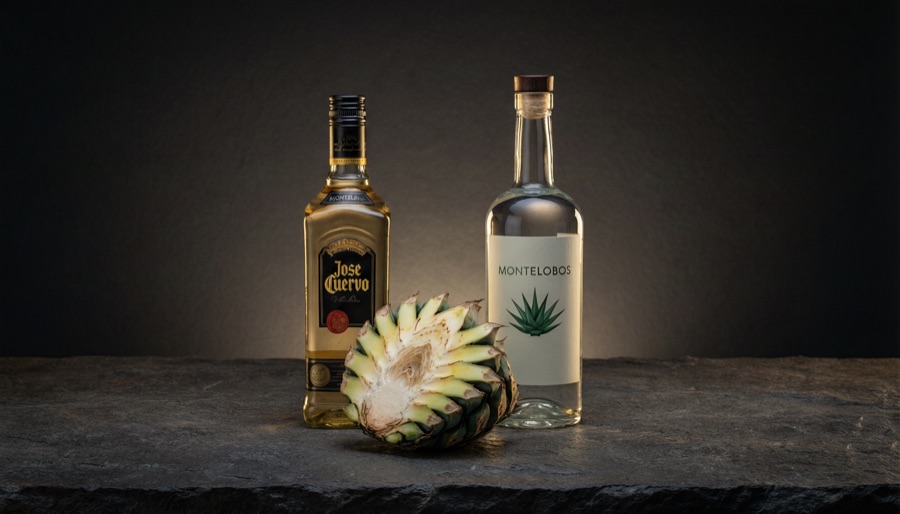
At harvest the leaves are shaved away, leaving the heart — the piña, which looks like a giant pineapple. Agaves store their energy as inulin rather than sucrose, so the hearts must be cooked long and slow before the sugars become fermentable. That cooking step is precisely where the two spirits' styles part ways.
Tequila: A System Built on Aging
Tequila's denomination of origin covers five Mexican states, with Jalisco at its core. Every bottle carries a NOM number identifying the distillery that produced it — quite a few famous brands share the same stills, so tracing a NOM can reveal surprising family ties.
The classification runs on time in wood. Blanco rests zero to two months and is the purest expression of the plant: citrus, black pepper, green herbs. Joven is usually a blend. Reposado — "rested" — spends 2–12 months in oak, picking up vanilla and soft caramel. Añejo ages 1–3 years, moving toward chocolate, toasted wood and a whisky-like weight. Extra Añejo passes three years and turns deep and polished. The modern twist is Cristalino: aged tequila charcoal-filtered back to clear, combining barrel texture with a bright look.
The single most important phrase on any label is "100% de Agave". Without it the bottle is a mixto — a 51% agave minimum, the rest filled in with other sugars, harsher in the glass. Starting with the 100% marking is never wrong.
Mezcal: Smoke from the Pit Oven
Mezcal's denomination covers nine states, and Oaxaca alone accounts for roughly 85% of production. Process is the root of flavor: tequila generally steams its piñas in above-ground ovens or industrial autoclaves, yielding clean sweetness, while mezcal roasts them for 3–5 days in pit ovens dug into the earth, lined with volcanic rock and fired with wood. The smoke, char and earthy minerality all come from that pit.
Distillation keeps the old ways alive. Many palenques run clay pots or small copper stills, usually distilling twice, which gives the spirit an oily, textured body. Two label terms are worth memorizing: Artesanal (pit-roasted, traditionally distilled) and Ancestral (older methods still, clay only). A bottle bearing neither is usually industrial production.
One myth deserves to die: smoke is not the whole of mezcal. Different agaves bring white flowers, green fruit, minerals and tobacco leaf. Great mezcal is about raw material and terroir, not just the fire.
Reading Labels, Choosing Bottles
For tequila, check three things: the "100% de Agave" marking, the aging category, and the NOM number. For mezcal, check three as well: the agave variety (Espadín is the best-value entry point; wild species cost more and shout louder), the Artesanal or Ancestral designation, and the proof — traditional mezcal lands between 45% and 55% ABV, and sub-40% export bottlings are often diluted.
Two widespread misconceptions can be retired. The "worm" at the bottom of the bottle is a mid-century marketing stunt with no link to quality, and "older is better" simply does not apply — mezcal prizes raw-material expression, and most classics are unaged.
Using Them Behind the Bar
For Margaritas and Palomas, reach for a tequila Blanco: bright acid and agave cut through short drinks, while Reposado's oak tends to vanish under citrus. For sipping, choose Añejo when you want wood and weight, or a high-proof Blanco when you want the plant itself. In cocktails, mezcal works as a natural smoke seasoning — a Mezcal Negroni, or 15–30 ml standing in for whisky in a Penicillin, lifts the whole drink a level.
Agave spirits remain one of the few categories where you can still taste raw material and terroir: different hillsides, harvest years and species all write their names into the glass. Once you understand the system, that crowded bottle wall finally makes sense.
More tips
274 cocktail recipes, one tap away
Browse by base spirit, flavor and strength. Save your favorites.
Open MixMyth