Acidity Balance & Acid Solutions: Citric, Malic Acid and Super Juice in Cocktails
Acidity Balance & Acid Solutions: Citric, Malic Acid and Super Juice in Cocktails
Acid is the skeleton of a cocktail. Sugar supplies roundness, alcohol supplies weight, but acid supplies direction and lift - it is what turns a sweet liquid into a structured drink. Professional bars have long moved past "squeeze some lemon": from distinguishing pH from titratable acidity, to dosing precise citric and malic acid solutions, to building acid directly into an ingredient via Super Juice, acidity management is a measurable craft.
pH vs Titratable Acidity: Two Different Dials
Many assume acidity is pH. It is not. pH measures free hydrogen-ion concentration and governs sharpness and microbial stability; titratable acidity (TA) measures the total acid load and governs the sheer volume of sourness. Two lemon juices with identical pH can differ twofold in TA and taste completely different. Lemon juice is dominated by citric acid - direct, bright, quick to finish. Lime leans even more citric with a trace of malic, reading sharper. Grapes, apples and underripe fruit are rich in malic acid, which is harder, longer-lasting and leaves a green, fruity tail. Understanding this explains why some recipes call for lemon, some for lime and some for both: you are tuning the type and ratio of acids, not merely the amount.
Acid Solutions: Turning Feel into Graduations
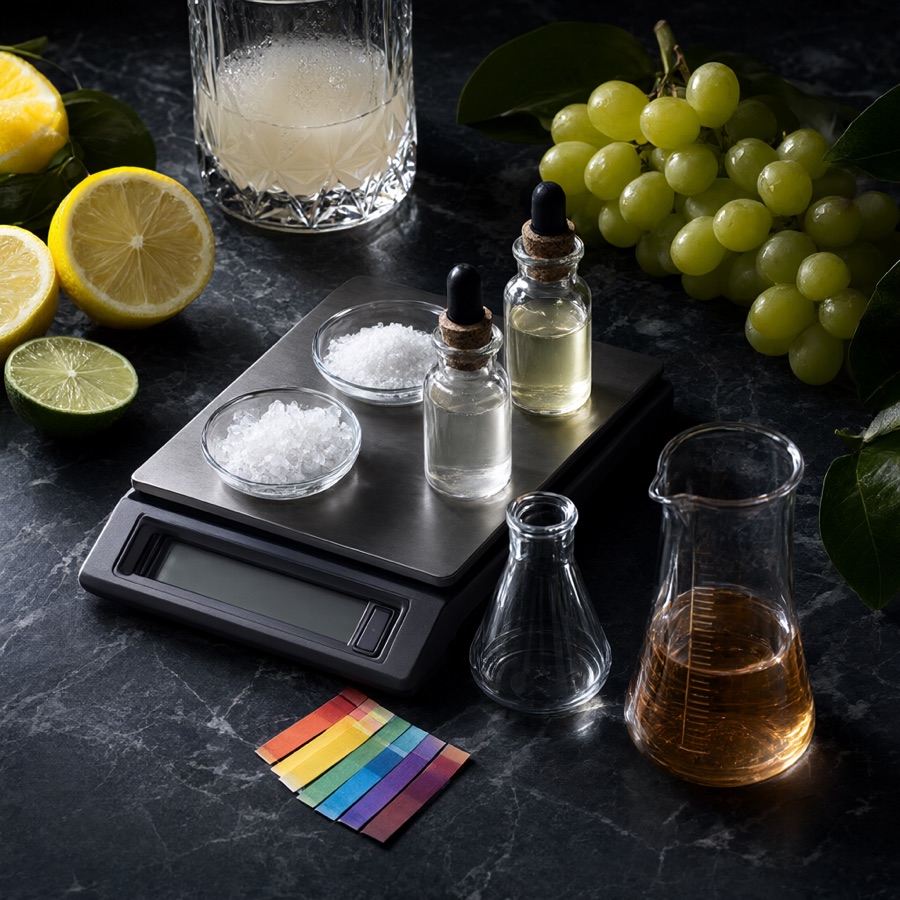
Fresh citrus acidity drifts with origin, season and ripeness; the same lemons can juice ten percent differently week to week. Bars chasing consistency stock standard acid solutions: citric and malic acid weighed and dissolved in distilled water. A common build is a ten percent citric solution to mimic lemon's bite, or a three-to-one citric-to-malic blend for a more layered fruit acid. Solutions are infinitely stable and doseable to a tenth of a millilitre, ideal for calibration and batching. Use them in drops or millilitres to fine-tune a finished drink: taste first, and if it is flat, add acid solution drop by drop rather than more juice - extra juice brings sugar, water and flavour and wrecks the balance, while acid solution adds only acid.
Super Juice: Building Acid into the Ingredient
Super Juice, also called acid-adjusted juice, is the signature modern technique: clarify a flavour-pure juice base by centrifuge or fining, then add weighed citric and malic acid to dial its acidity up to a target fruit's level. Clarified watermelon or cucumber juice, acid-adjusted to lime's structure, keeps the melon's sweetness or the cucumber's perfume while gaining the backbone citrus would provide. The result is constant acidity, clean flavour and long fridge life, and it solves the problem of fruits too low in acid to carry a drink alone. Super Juice is not about replacing citrus; it is about widening the flavour dimension of acid so sourness is no longer a single lemon face.
Ratios and Common Pitfalls
A practical starting point: the classic sour sits around an acid-to-sugar ratio of one to three-quarters up to one to one (thirty millilitres of lemon to twenty or twenty-five of simple syrup), adjusted for spirit strength. Four recurring mistakes: memorising recipes without tasting acidity, so a sweeter batch of lemons unbalances the whole drink; substituting bottled lemon juice, which is pasteurised and oxidised and tastes dull; correcting flatness with more juice instead of acid solution, diluting as you go; and ignoring malic acid, so citric-only drinks taste thin and short - a touch of malic lengthens the acid line. When recording, keep a small card for each batch of citrus: date, origin, yield, pH, and a subjective acidity score from tasting the house recipe. After a few weeks you will have an acidity baseline unique to your bar, an anchor for both new development and batching.
Acidity with Temperature, Dilution and Carbonation
Sourness never acts alone; temperature, dilution and carbonation amplify or mute it. Cold suppresses acid's sharpness, so a well-iced long drink can carry more acidity than a room-temperature tasting suggests, while a warm drink turns harsh if over-acidified and needs slightly less acid or more sugar. Dilution matters just as much: the water a shake or stir introduces thins both acid and sugar but does not change their ratio, so a premix should be designed at the final served concentration, not the concentration in the tin. Carbonation adds an illusion of extra acidity - dissolved CO2 forms carbonic acid, weak in itself, yet its prickling brightness on the tongue makes fizzy builds taste sharper and crisper at the same lemon dose. Grasping these three interactions explains why one recipe tastes different over ice versus neat, rested versus freshly made. There is no shortcut: weigh, record, re-taste, and write every adjustment down until feel becomes a repeatable standard.
More tips

320 cocktail recipes, one tap away
Browse by base spirit, flavor and strength. Save your favorites.
Open MixMyth