Absinthe: A Complete Guide to the Anise Family, the Louche Ritual and Its Role in Cocktails
Absinthe's Three Identities: Spirit, Herbal Infusion, Cultural Symbol
Absinthe is an oddity in the cocktail canon: neither a base spirit nor an ordinary liqueur, but a high-proof "seasoning spirit" that carries a dense herbal payload. Understanding it means holding three threads at once - the flavour architecture set by distillation, the physical behaviour of anise oils, and the drop-by-drop logic it obeys in classic recipes.
Botanicals and Distillation: A Three-Part Herbal Layer
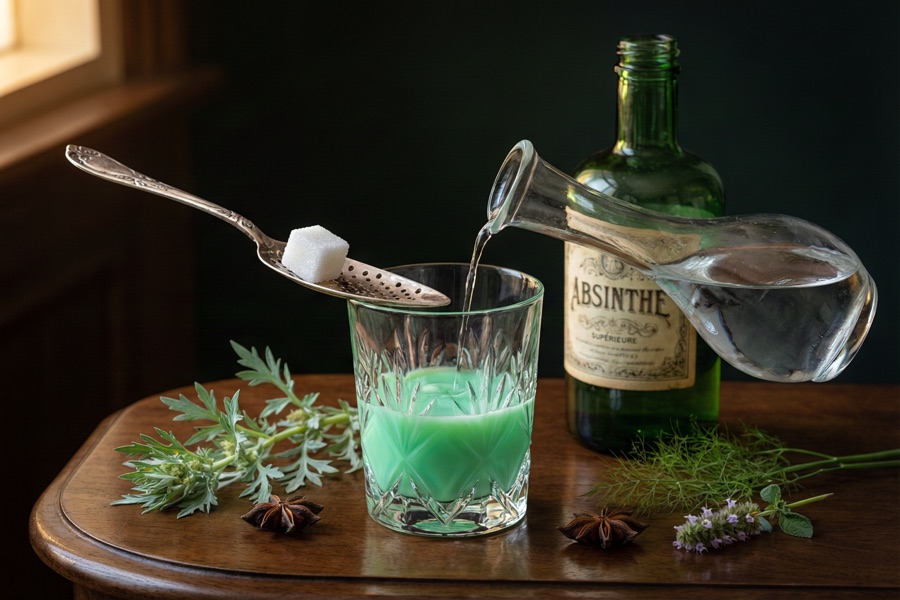
Traditional absinthe rests on three botanicals: grand wormwood (Artemisia absinthium), which supplies the bitter backbone and trace thujone; green anise, which carries the dominant anise aroma; and Florence fennel, which rounds the finish with a sweeter anise tail. Production runs in two passes. First, the botanicals are macerated in high-proof neutral spirit and distilled, yielding a colourless base. Then a second charge of herbs - chiefly wormwood leaf, hyssop and lemon balm - is cold-steeped in that base to extract chlorophyll and fine aromatics, giving Verte (green) its signature jade. Blanche (white, called La Bleue in Switzerland) skips the colouring steep and stays crystal clear, with a more direct, sharper herbal edge. Bottling strength typically runs 45% to 74% ABV, far above most liqueurs - which is exactly why it appears in recipes only as dashes or a rinse.
The Louche: A Physics Lesson in Anise Oil
Add water and absinthe turns from clear to a milky opalescence; the phenomenon is called the louche (French for "cloudy"). Anethole and related oils stay dissolved in high-proof alcohol, but once water drops the strength below roughly 45%, the oils lose their solvent and precipitate as micron-scale droplets that scatter light. This is a quality signal, not a flaw: a fine absinthe louches slowly and in layers - first a haze, then a rolling cloud, finally a settled jade; a poor one snaps to a flat, dead white. The classic French ritual - a sugar cube on a perforated spoon, iced water dripped at 3:1 to 5:1 - exists to showcase this transition while taming the proof.
Historical Coordinates: The Green Hour, Prohibition, and the Modern Revival
Absinthe's modern image was forged in three acts. In late nineteenth-century France the "green hour" (l'heure verte) was a national ritual: at five in the evening every cafe table held a milky green glass, cheap intoxication for the working class and muse for the bohemians - Van Gogh, Toulouse-Lautrec and Wilde all left their mark on it. Around the 1910s Switzerland, France and the United States banned it as "hallucinogenic", with trace thujone scapegoated as the culprit; for nearly a century absinthe survived only in the grey zone, reborn under names like Pastis. From the 1990s the EU and Switzerland lifted the bans and set thujone ceilings, and legal modern absinthe returned to the bar. This history is not nostalgia: it explains why classic recipes dose absinthe so sparingly - in its pre-ban context it was always meant to be tamed by water and sugar before it ever reached the lips.
In Cocktails: The Drop-by-Drop Modifier
Absinthe almost never acts as a base; it is an aromatic modifier. Three canonical uses: a rinse, as in the Sazerac, where the chilled glass is swirled with absinthe and emptied, leaving an anise veil beneath rye and Peychaud's bitters; dashes, as in the Corpse Reviver No.2 and Monkey Gland, where a few drops bridge citrus and gin with an herbal arc; and as a louche showcase, as in Death in the Afternoon, where Champagne opens the absinthe and the jade bloom rises through the glass. Discipline is strict: per 60ml of base spirit, one to three dashes (about 0.5 to 1.5ml) is the working range. More, and anise flattens the whole drink.
Flavour Pairing: The Herbal Spectrum Beyond Anise
Absinthe's value runs deeper than anise. Its bitter backbone can prop up a sweet sherry or sweet vermouth, standing a too-sweet drink back on its feet; its herbal tail answers citrus oils and celery salt with a savoury echo, a hidden depth in savoury cocktails; and its complexity is a natural bridge between smoky mezcal and aged rum, threading peat and oak into a single line. When building originals, treat absinthe as "herbal bitters, amplified": set the base spirit and the sweet-sour frame first, then add one or two dashes for vertical lift, and finish with citrus or spice for horizontal brightness. If the base already carries heavy smoke or peat, cut the absinthe or drop it entirely - otherwise herb and smoke mask each other and the drink collapses into a muddy bitter.
Buying, Storing, and Substituting
Judge three things on the label: distilled beats macerated; the ABV and botanical list are printed; and a Verte should show a natural herbal green, not a dyed neon. Once open, anise oils oxidise slowly - use within six to twelve months, stored upright away from light. Without absinthe on hand, Pastis (such as Ricard: anise-forward, sweetened, lower proof) substitutes 1:1 for rinses and dashes, but remember it carries its own sugar, so trim sweetener elsewhere; Herbsaint is the common American stand-in. Never fake it with anise extract or ordinary bitters - they lack the distilled herbal depth and layering.
More tips
274 cocktail recipes, one tap away
Browse by base spirit, flavor and strength. Save your favorites.
Open MixMyth